

Software must work well from the start. Users do not like bugs, slow pages, or broken features. If a product fails, users leave. That is why testing is so important. Good testing helps teams find problems before users do. However, writing strong test cases takes time. It also requires careful thinking. As software becomes more complex, testing becomes harder.
Many teams still write test cases by hand. This method works, but it can be slow. Testers may miss rare cases. They may repeat steps. Requirements may also change during development. When that happens, test cases must be updated again. This increases pressure on the team.
Today, there is a smarter way to design test cases. Generative AI helps teams create clear and detailed test cases in less time. It studies the requirements and suggests useful scenarios. Testers can then review and improve them. This saves effort and improves quality.
In this blog, we explain how AI supports test case design. We also share how it works in real projects. Most importantly, we show why combining human skills with AI tools leads to better software.
Why Traditional Test Case Writing Is Difficult
Manual test case writing has limits. It depends on human focus and memory. Even skilled testers can miss things.
Common problems include:
- Missing edge cases
- Repeating test steps
- Slow updates when requirements change
- Limited coverage in large systems
As systems grow, testing becomes more complex. For example, a platform that manages users, billing, reports, and schedules can have many possible paths. Checking all of them manually takes a lot of time.
Because of this, teams need support that improves speed and coverage at the same time.
What Is Generative AI in Testing?
Generative AI is a type of artificial intelligence that creates content. In software testing, it can create:
- Test cases
- Test steps
- Input data
- Validation scenarios
You provide the requirements. The AI reads them. Then it suggests possible test cases.
For example, if the system allows users to register, AI may suggest:
- Valid registration
- Invalid email format
- Weak password
- Empty required fields
- Duplicate account attempt
This helps testers think in a wider way.
How Generative AI Improves Test Case Design
1. Better Test Coverage
AI reviews all given requirements. It checks different user actions and system responses. This reduces the chance of missing important cases.
Better coverage means fewer bugs after launch.
2. Faster Test Case Creation
Writing test cases from scratch takes hours. With AI, teams get a first draft in minutes.
Testers then review and adjust the output. This saves time and reduces stress.
3. Strong Edge Case Suggestions
Edge cases are rare but important. AI often suggests cases like:
- Very large input values
- Special characters
- Network failure
- Multiple users at the same time
These checks make the system stronger.
4. Clear and Simple Structure
AI-generated test cases usually follow a clear format:
- Test name
- Steps
- Expected result
This makes documentation easier to read and share.
A Simple Real Project Example
In one of our projects, we built a news delivery management system for administrators. The system helped manage customers, delivery rounds, billing, and returns. Since all features were connected, testing needed wide coverage.
We used Generative AI to support requirement review and test case creation. AI helped us create test cases for order flows, billing rules, and delivery schedules. This reduced manual effort and improved stability before launch.
You can read the full case study here. This example shows that AI works best when combined with human review. The team still checked every test case before approval.
Human Review Is Still Important
AI is helpful, but it is not perfect. It does not fully understand business goals. It also does not know customer emotions.
The best method is simple:
- Share clear requirements with AI.
- Generate test cases.
- Review them carefully.
- Add business rules if needed.
- Approve the final version.
In this way, AI supports speed, and humans ensure accuracy.
Business Benefits of Using AI in Testing
Using Generative AI brings clear benefits.
Saves Time
Teams spend less time writing repetitive steps.
Reduces Cost
Less manual effort lowers testing costs.
Speeds Up Delivery
Faster testing means faster releases.
Improves Quality
Better coverage reduces production issues.
Best Practices for Success
To get strong results, follow these tips:
Start Small
Use AI on one feature first.
Write Clear Requirements
Clear input gives better output.
Train the Team
Testers should know how to review AI results.
Track Results
Measure time saved and bug reduction.

The Future of AI in Test Case Design
Software is growing fast. Users expect updates quickly. Because of this, testing must also improve.
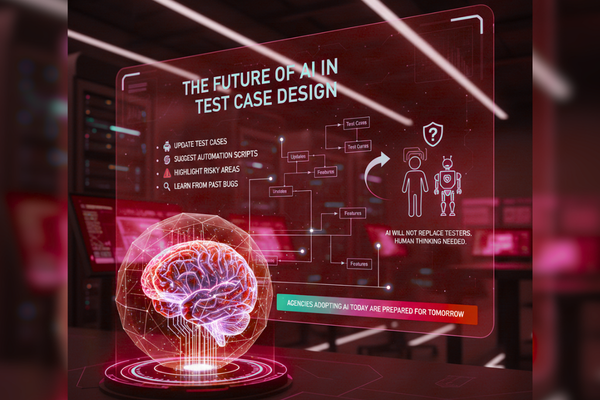
In the future, AI may:
- Update test cases when features change
- Suggest automation scripts
- Highlight risky areas
- Learn from past bugs
However, AI will not replace testers. Human thinking will always be needed.
Agencies that adopt AI tools today are better prepared for tomorrow. They work faster and deliver stable systems.
Conclusion
Good testing builds strong software. When test cases are clear and complete, products perform better. Users face fewer problems. Businesses gain trust. However, manual test case writing can be slow and tiring. As systems grow, the workload increases. Teams may struggle to keep up.
This is where Generative AI makes a difference. It helps teams create test cases quickly and clearly. It suggests new scenarios and improves coverage. Instead of starting from zero, testers begin with a structured draft. They then review and improve it. This saves time while keeping control in human hands.
Our experience shows that AI works best as a support tool. It handles patterns and large amounts of data. Humans handle business logic and final decisions. When both work together, results improve.
For software development agencies, this approach offers real value. It reduces effort, speeds up release cycles, and improves quality. It also allows teams to focus on strategy instead of repetitive tasks.
The goal is simple. Build reliable systems. Deliver updates faster. Reduce risk before launch. AI helps achieve these goals, but human expertise remains essential.
In the end, better test cases lead to better software. And better software builds long-term trust. By using AI wisely and responsibly, teams can improve their testing process without losing control. The future of testing is not about replacing people. It is about giving them better tools to succeed.
FAQs
- Can AI replace testers?
No. AI supports testers but does not replace them. - Is AI-generated testing safe?
Yes, when reviewed properly. - Does AI really save time?
Yes. It speeds up test case creation. - Can AI test complex systems?
Yes, with clear requirements.