

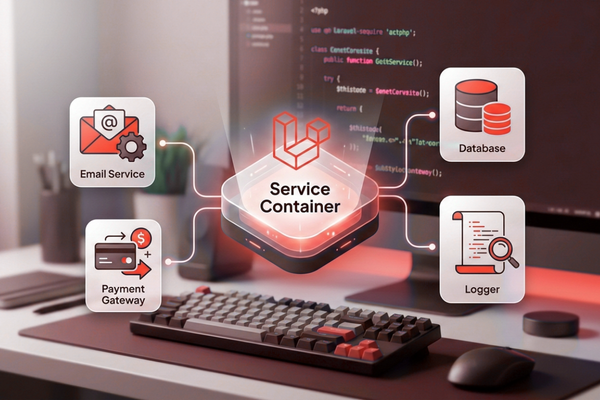
Have you ever wondered how top-tier web applications stay organized as they grow larger? Imagine building a massive digital skyscraper. If you do not have a solid blueprint, you will eventually face structural problems that are impossible to fix without tearing the whole thing down. In the world of web development, specifically with the PHP framework Laravel, developers often face this “code-spaghetti” challenge. As applications expand, managing how different parts of your software communicate becomes increasingly difficult. Without a clear plan, the software becomes brittle, hard to update, and expensive to maintain.
Fortunately, there is a powerful tool designed to solve this exact problem: the Laravel Service Container. It acts as the organizational backbone of your application, ensuring that different components are connected in a clean, orderly, and efficient way. Many developers hear the term and feel intimidated, thinking it requires an advanced degree in computer science to understand. However, the concept is remarkably simple once you visualize it correctly. By mastering this tool, you can create applications that are easier to test, update, and scale over time. In this guide, we will break down exactly what this feature is, why it matters, and how you can use it to build better software without getting lost in complex technical jargon.
What is a Service Container?
Think of a large, busy restaurant kitchen. If every chef had to build their own stove, hunt for their own ingredients, and construct their own utensils every time they wanted to cook a meal, nothing would ever get done. It would be chaotic and inefficient.
Instead, a well-run kitchen has a central storage room, often called the pantry or the supply hub. When a chef needs a specific tool, like a whisk, a blender, or a specific pan, they do not go out and manufacture the tool themselves. They simply ask the kitchen manager to provide it. They do not need to know how that blender was built or where it was bought; they just need it to work so they can prepare the meal.
In your software application, the Laravel Service Container acts just like that kitchen manager. It is a powerful tool for managing how different parts of your application get the “tools” they need to function. Instead of manually creating new objects or parts every time you need them, you ask the container to provide them for you. You simply ask for what you need, and the container delivers it, already prepared and ready to use. This makes your software much cleaner because the main logic of your application does not have to worry about the “behind-the-scenes” setup process.
The Problem with Manual Management
When developers do not use a container, they often resort to manually creating every single part of their system exactly where they need it. Think of this like buying furniture from a store, but instead of just buying the chair, you have to source the wood, forge the nails, and weave the fabric yourself every single time you need to sit down.
This creates “tight coupling.” In simple terms, this means your software parts are stuck together like glue. If you want to change one part, you have to break the glue, remove the part, replace it, and then re-glue everything else. If you make a mistake in one spot, the whole system might crash. This makes software incredibly fragile. As soon as a project grows past a few simple pages, manual management becomes a burden that slows down your entire team and leads to costly errors.
Why Should Your Application Use It?
You might wonder why you cannot just create objects manually as you have always done. While simple applications might get away with it, larger projects will struggle. Here are three reasons why this approach is superior for the long-term health of your project:
1. Better Organization and Centralization
When you rely on the container, you centralize the setup of your services. Imagine having a single rulebook for your entire house. If you want to change the lightbulbs, you check the rulebook, and it tells you exactly what to do. If you ever need to change how a service works, for example, if you switch your email provider, you do not have to hunt through hundreds of files to fix it. You update it in one central location, and the change reflects everywhere.
2. Easier Testing
Testing is crucial in professional software development. If your code is “hard-wired” to specific services, testing it becomes a nightmare because you cannot easily swap out real services for fake ones during testing. By using a container, you can easily “swap” dependencies. This allows you to run simulations where you test how your application behaves without actually sending real emails or charging real credit cards. It makes your code much friendlier to automated tests.
3. Future-Proofing
Business requirements change. A feature that works perfectly today might need a massive overhaul next year. When your classes are loosely connected through a container, swapping out a feature is simple. This flexibility is exactly what we prioritized when we worked on projects like our Full Fork case study, where maintaining a clean architecture allowed for smooth growth and functionality updates without disrupting the user experience.

Understanding the “Ask” Process

To understand how the Laravel Service Container works in practice, imagine it as a catalog.
First, you “register” your items in this catalog. You tell the container: “Whenever someone asks for an Email Sender, give them the standard version.” This happens once, at the start.
Second, when you are actually writing your code, you do not need to worry about creating the Email Sender. You just “ask” for it. You might say, “Hey, I need an Email Sender to finish this task.” The container checks its catalog, sees that you registered the standard version, and hands it over to you instantly.
This process removes the burden of construction from your daily work. You are no longer building tools; you are just using them. This makes your code readable, clean, and professional. It allows developers to focus on what the application should do, rather than how the application should be built.
Best Practices for Success
To get the most out of your container, keep these tips in mind:
- Don’t Over-Engineer: You do not need to put every tiny detail in the container. Use it for major services that are shared across your application or ones that might change in the future.
- Keep it Simple: Always try to bind things to simple names that make sense to your team.
- Keep Providers Small: Do not dump all your logic into one giant storage file. Break them up into smaller, focused files to keep your project organized.
By following these habits, you ensure that your codebase remains readable for other developers and maintainable for your future self. It turns your development process from a chaotic struggle into a streamlined, professional workflow.
Conclusion
In summary, adopting the Laravel Service Container is one of the most effective steps you can take toward becoming a more proficient developer or building a more stable business application. We have explored how this architectural pattern acts as a central hub, allowing your application to manage components with grace and efficiency. Instead of manually instantiating classes throughout your code, which leads to tightly coupled and fragile systems. You can rely on the container to deliver the objects you need, exactly when you need them.
This transition in thinking is essential for anyone aiming to move from “writing code that works” to “building software that lasts.” As we highlighted in our previous work, modern web development relies heavily on an architecture that can adapt to change. When you decouple your components, you are essentially buying yourself an insurance policy against future technical debt. You make your system easier to test, simpler to refactor, and much more manageable for teams to collaborate on.
Furthermore, the beauty of this approach is that it makes your codebase a much friendlier place for new developers joining your team. When logic is centralized and dependencies are clearly defined, new team members can grasp how the system functions much faster. They are not left guessing how a part is constructed or where its data comes from; they can simply look at the service configuration to understand the workflow.
Ultimately, mastering this container is not just about writing “cleaner” code; it is about building a foundation that supports innovation. Whether you are building a small internal tool or a massive e-commerce platform, the principles remain the same. Start by experimenting with these concepts in your current projects, and you will quickly see why seasoned Laravel developers consider this feature the secret weapon for scaling successful applications. Happy coding, and may your architecture always be strong.
Frequently Asked Questions
Q: Is the service container only for large projects?
A: Not necessarily. It is helpful for any project, but its benefits become most obvious as your application grows and you need to keep code clean.
Q: Is learning this difficult?
A: It can feel abstract at first, but with a bit of practice, it becomes second nature to think about how your services are connected.
Q: Can I use this with other frameworks?
A: Other frameworks have similar concepts, but the Laravel Service Container is specific to Laravel’s ecosystem and is one of its most powerful features.