

Today’s users expect software to be fast, smooth, and always available. However, many applications are built in a way that makes growth slow and risky. At the start, everything works fine. But as more features are added, systems become heavy and hard to manage.
This usually happens because the application is built as one large system. Every feature depends on another. A small update can cause big issues. Fixing bugs takes time. Scaling becomes expensive. As a result, teams struggle to move fast.
This is where microservices offer a better way. Instead of building one large system, microservices split the application into smaller parts. Each part works on its own and focuses on one task. This makes updates easier and safer.
When microservices are built using the MERN stack, the process becomes even simpler. MERN uses JavaScript from start to end. This reduces confusion and speeds up development.
In this blog, we explain Microservices with MERN in a very simple way. You will learn why monolithic systems slow growth, how microservices fix common problems, and how MERN supports speed and flexibility.
What Is a Monolithic Application?
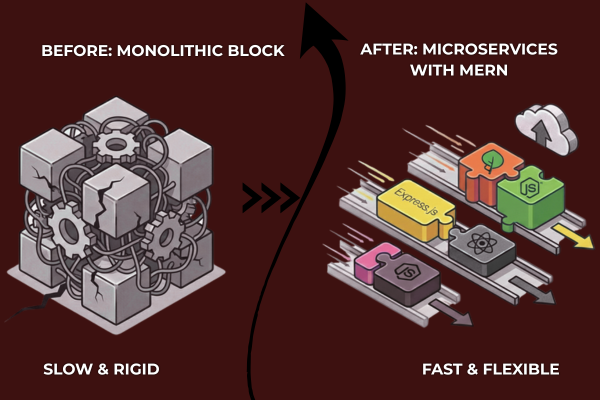
A monolithic application is built as one single unit. All features, logic, and data live together. At first, this feels easy to manage.
However, problems start as the system grows. One small change can affect the entire application. Testing becomes slow. Deployment becomes risky. If one part fails, the whole system can stop working.
Because everything is connected, scaling one feature means scaling everything. This increases cost and reduces performance. Over time, the system becomes hard to improve.
What Are Microservices?
Microservices break an application into small and independent services. Each service handles one task only. For example, one service manages users, another handles payments, and another sends notifications.
These services communicate with each other via simple APIs. Since they are separate, teams can update one service without touching others. If one service fails, the rest keep running.
As a result, systems become more stable, flexible, and easier to grow.
Why MERN Works Well With Microservices
The MERN stack includes MongoDB, Express.js, React.js, and Node.js. All these tools use JavaScript. This makes development smooth and consistent.
Here is why MERN fits microservices perfectly:
- Node.js is fast and handles many users easily
- Express.js keeps APIs clean and simple
- MongoDB works well with flexible data
- React.js supports reusable front-end parts
Together, they make Microservices with MERN easy to build, update, and scale without stress.
How to Break a Monolith Into Microservices
You do not need to rebuild everything at once. A slow and planned move works best.
First, find features that change often. These are good starting points. Next, separate their logic and data. Then, turn them into independent services.
Over time, more parts can be moved. This reduces risk and keeps the system stable during the change.
How Microservices Improve Speed
Speed is not just about performance. It is also about how fast teams can release updates.
With microservices, each service is deployed on its own. Teams do not need to test the entire system for small changes. This saves time and effort.
As a result, updates reach users faster. Businesses can react quickly to market needs.
How Microservices Improve Flexibility
Microservices allow each feature to grow based on demand. If one service needs more power, only that service is scaled.
This avoids waste and lowers cost. New features can be added without rewriting the whole system. Teams also gain freedom to improve parts without fear.
That is why Microservices with MERN is a smart choice for growing products.
A Real Project Example
We have applied this approach in real projects with strong results. In one large platform, we helped move from a heavy system to a clean microservices setup using MERN.
The result was faster releases, fewer errors, and better system control. Teams could manage updates without delays.
You can see how we did on this project by exploring this case study:
View the project case study
This example clearly shows how planning and the right tools lead to long-term success.
Common Challenges and Simple Solutions
Microservices need planning. Without it, systems can become messy.
Breaking services too quickly is a common mistake. Poor communication between services is another. However, these issues are easy to avoid.
Start small. Define clear goals. Use simple APIs. Test often. These steps keep systems clean and reliable.
Security and Maintenance Benefits
Microservices improve security by limiting access between services. If one service has an issue, others stay safe.
Maintenance also becomes easier. Updates can happen without full system shutdowns. This improves uptime and user trust.
When Should Businesses Use Microservices?
Microservices work best for growing applications. If frequent updates, speed, and scale matter, this approach makes sense.
Even small teams can benefit if they plan carefully and grow step by step.
Conclusion
Software should help businesses grow, not slow them down. Sadly, many systems struggle because they were built without future growth in mind. Large applications often become hard to manage. Updates feel risky. Performance drops over time.
Microservices solve these problems by breaking systems into smaller parts. Each part works on its own. This makes updates safer and faster. Teams can fix issues without fear. Scaling becomes simple and cost-effective.
When microservices are built with MERN, things become even easier. Using one language across the system reduces confusion. Teams work better together. Maintenance becomes less stressful. This is why Microservices with MERN is becoming a popular choice.
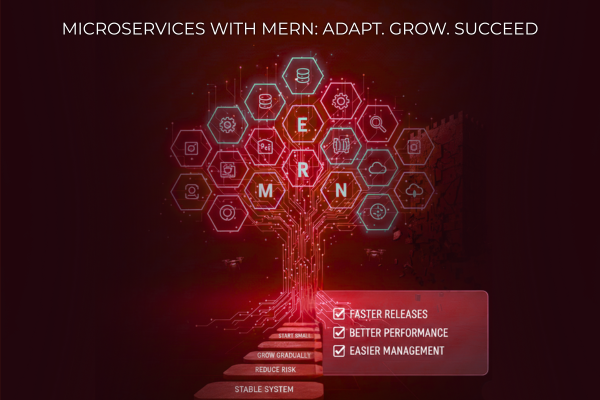
The key is planning. Businesses should move step by step. They should start small and grow gradually. This reduces risk and keeps systems stable.
Real projects prove that this approach works. Faster releases, better performance, and easier management are common results. More importantly, systems stay ready for future needs.
In a fast-changing digital world, flexibility matters. Microservices powered by MERN give businesses the tools they need to adapt, grow, and succeed without technical roadblocks.
FAQs
Q1: Is MERN good for microservices?
Yes, it supports speed and flexibility.
Q2: Can old systems be converted?
Yes, with a gradual approach.
Q3: Is maintenance difficult?
No, it becomes easier over time.
Q4: Does this reduce costs?
Yes, especially in the long run.