NeuroAscent: Gamified Medical Anatomy Learning Platform

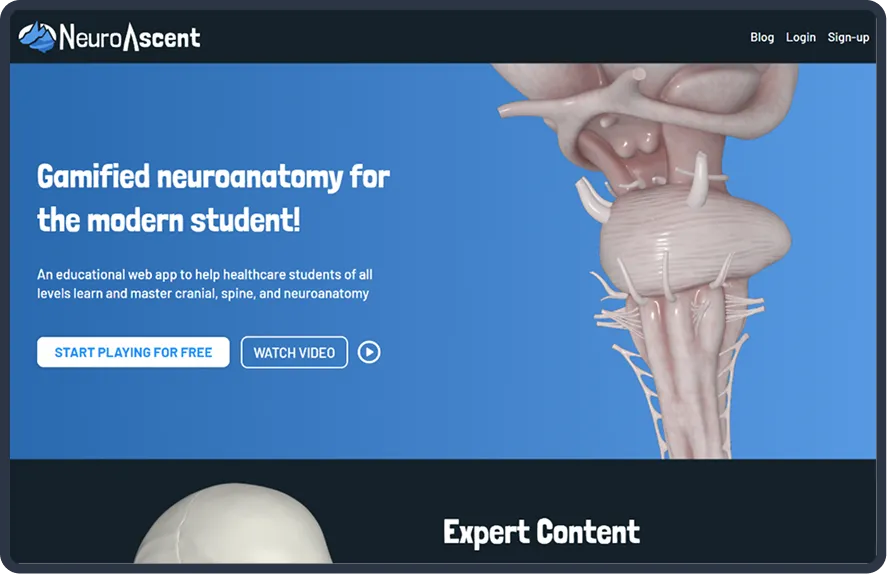
Canadian Software Agency partnered with NeuroAscent to expand and evolve a medical anatomy learning platform designed specifically for healthcare students. The objective was to transform an already functional anatomy study tool into a fully-featured gamified educational ecosystem that improves knowledge retention, increases student engagement, and delivers interactive learning experiences across cranial, spinal, and neuroanatomy curricula.

Industry

EdTech / Medical Education

Platform

Web Application

Launch

January 24, 2023

About the NeuroAscent

NeuroAscent combines spaced-repetition learning algorithms, competitive gameplay mechanics, interactive 3D anatomical visualisations, leaderboards, achievements, and expert-reviewed educational content into a single Progressive Web App accessible across desktop and mobile devices.

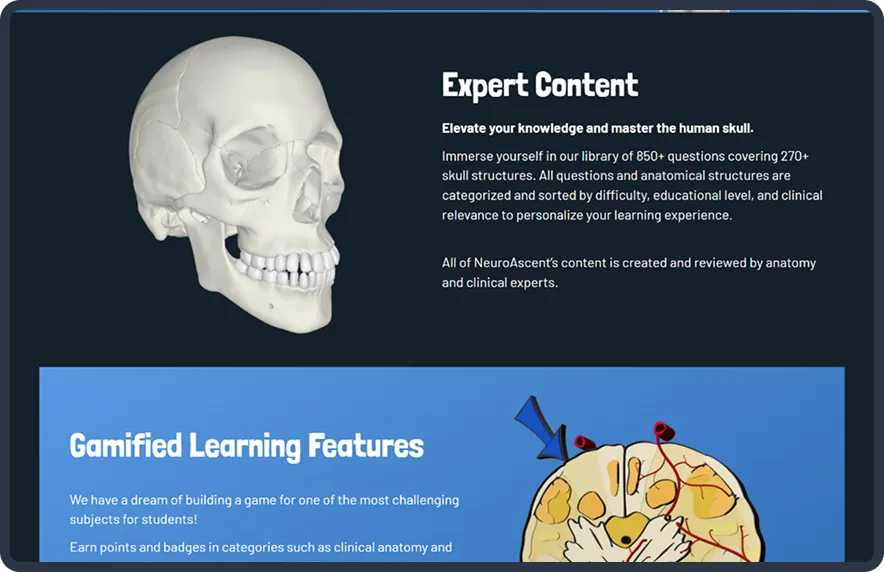
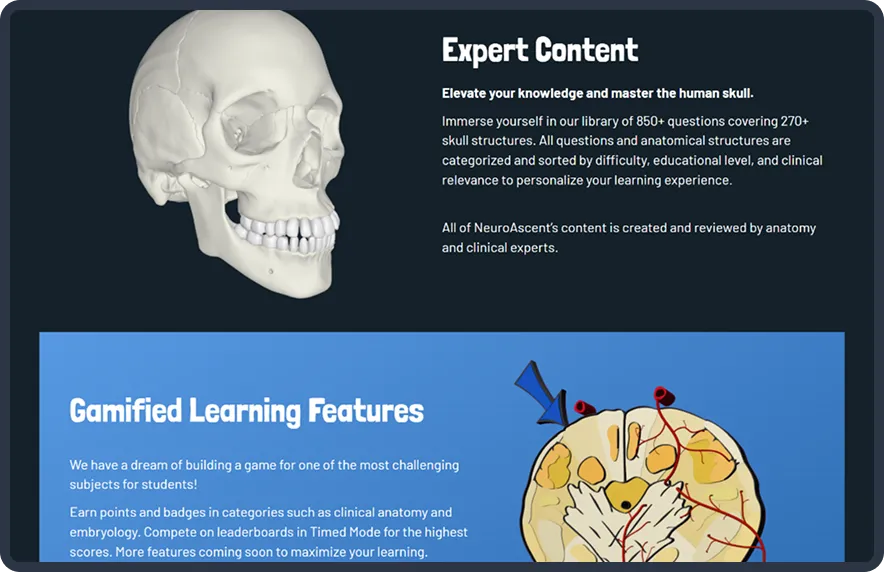
The platform now supports over 850 expert-reviewed questions covering more than 270 anatomical structures, with continuous expansion into spinal anatomy and neuroanatomy learning modules.

Timeline

Approximately 12+ months

Total Development Effort

Multi-phase full-stack development engagement

Team Size

5+ specialists

Key Deliverables
Gamified anatomy learning platform expansion
Flashcard-based spaced repetition learning system
Timed competition gameplay mode

The Challenge

Medical anatomy is one of the most demanding areas of healthcare education. Traditional learning methods such as textbooks, memorisation, and static flashcards often struggle to provide long-term retention or maintain student engagement.

The NeuroAscent platform required significant expansion to support:

The inherited codebase already included a working learning loop and foundational architecture, but additional gameplay systems, social engagement features, and scalable learning infrastructure were required to transform the product into a complete educational platform.

The Solution

Canadian Software Agency inherited and expanded the existing React.js frontend, Django backend, MySQL database infrastructure, Redis caching layer, and Docker-based deployment architecture.

The platform was enhanced through carefully structured development sprints focused on:

The resulting architecture separates frontend presentation, backend business logic, asynchronous processing, and database management into modular services, enabling scalable feature expansion without disrupting the existing learning ecosystem.

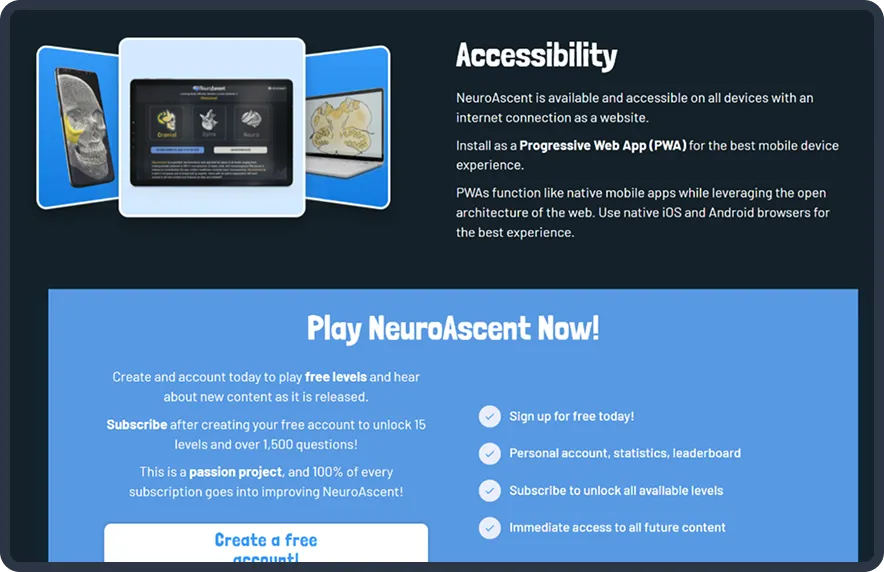
The final product delivers an engaging and scientifically grounded anatomy learning experience accessible directly through modern web browsers and installable as a Progressive Web App on iOS and Android devices.

Core Platform Features

The objective was to transform an already functional anatomy study tool into a fully-featured gamified educational ecosystem that improves knowledge retention, increases student engagement, and delivers interactive learning experiences across cranial, spinal, and neuroanatomy curricula.

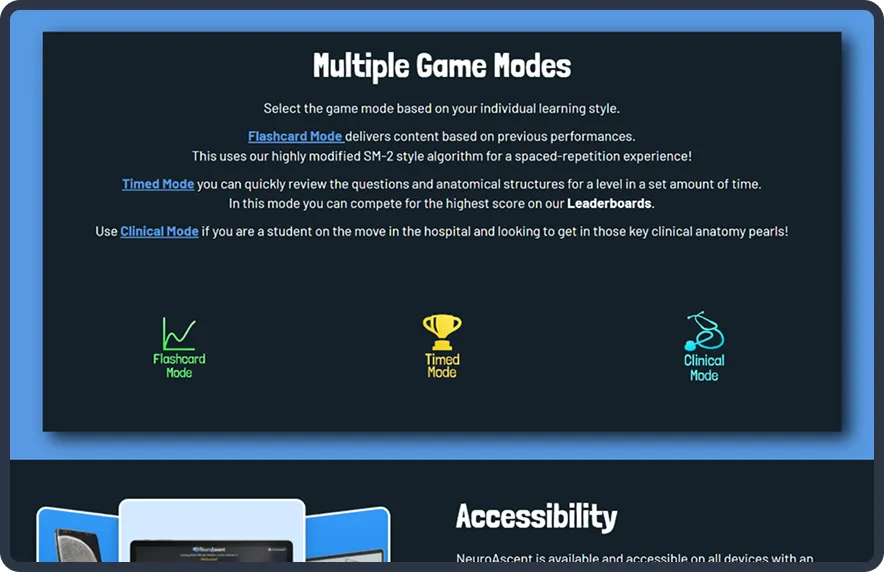
Flashcard Learning Mode

NeuroAscent’s Flashcard Mode is powered by a modified SM-2 spaced-repetition algorithm designed to improve long-term retention of anatomical knowledge.

Students:

  • Select worlds and levels
  • Interact with anatomy-based multiple-choice questions
  • Receive adaptive question delivery based on performance
  • Earn points based on response speed and accuracy
  • Progress through increasingly advanced anatomy content

The learning engine dynamically reinforces weaker knowledge areas while reducing repetition of mastered content.

Timed Competition Mode

Timed Mode introduces a competitive gameplay experience where students compete for leaderboard rankings.

Features include:

  • Time-based anatomy challenges
  • Deterministic content delivery
  • Competitive scoring system
  • Global ranking support
  • Institution and cluster-based leaderboards
  • Balanced scoring algorithms for fair competition

Unlike Flashcard Mode, Timed Mode uses fixed-sequence question delivery to ensure equal challenge levels for all participants.

Clinical Review Mode

Clinical Mode was designed specifically for students in clinical placements who require rapid anatomy revision in fast-paced healthcare environments.

The mode provides:

  • Quick-access review sessions
  • Clinically relevant anatomy questions
  • Mobile-optimised workflows
  • Efficient revision experiences for hospital and clinical use

Interactive 3D Anatomical Visualisations

One of NeuroAscent’s most distinctive features is its WebGL-powered 3D anatomy experience built with Three.js.

Students can:

  • Interact with detailed anatomical structures
  • Study spatial relationships visually
  • Explore cranial, spinal, and neuroanatomy models
  • Learn through immersive browser-based rendering

The 3D environment is fully accessible through standard browsers without plugins or native applications.

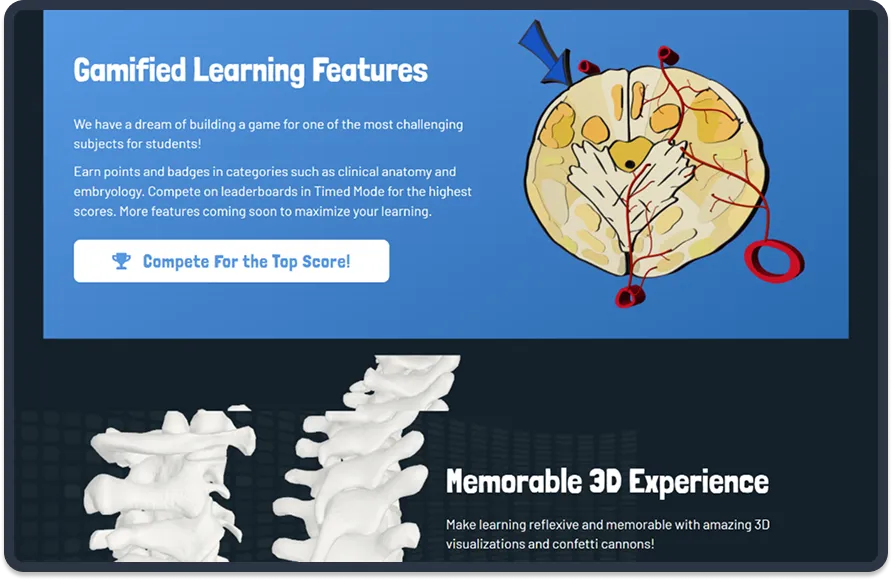
Leaderboards & Gamification System

To improve long-term engagement, Canadian Software Agency expanded NeuroAscent’s competitive gamification systems.

The platform now includes:

  • Global leaderboards
  • Institution-specific rankings
  • Session-based scoring
  • Weekly activity tracking
  • Badges and achievements
  • Reward progression systems
  • Competitive gameplay loops

These features encourage consistent study habits while creating a socially engaging educational environment.

Educational Tooltips & Reinforcement

At the completion of every question, students receive contextual educational facts and explanations related to the anatomical structure being studied.

This system:

  • Reinforces learning immediately
  • Increases educational value per interaction
  • Encourages deeper conceptual understanding
  • Integrates seamlessly into the gameplay experience

Statistics & Achievement Dashboard

Students gain detailed visibility into their learning performance through advanced statistics and achievement tracking.

The dashboard provides:

  • Accuracy tracking
  • Response-time analytics
  • Category-specific performance breakdowns
  • Difficulty-level analysis
  • Achievement progression
  • Weak-area identification

This allows students to personalise their revision strategies more effectively.

Content Error Reporting System

Canadian Software Agency implemented a built-in reporting system enabling students to flag inaccuracies directly during gameplay.

The reporting infrastructure:

  • Captures gameplay context automatically
  • Logs user feedback into dedicated database tables
  • Provides administrators with actionable moderation data
  • Streamlines educational content maintenance

Progressive Web App (PWA)

NeuroAscent was delivered as a Progressive Web App, enabling installation directly from the browser onto iOS and Android devices.

Benefits include:

  • Cross-device accessibility
  • Native-app-like experience
  • Home screen installation
  • Simplified maintenance through a unified codebase
  • Improved accessibility without app store dependency

Subscription & Freemium System

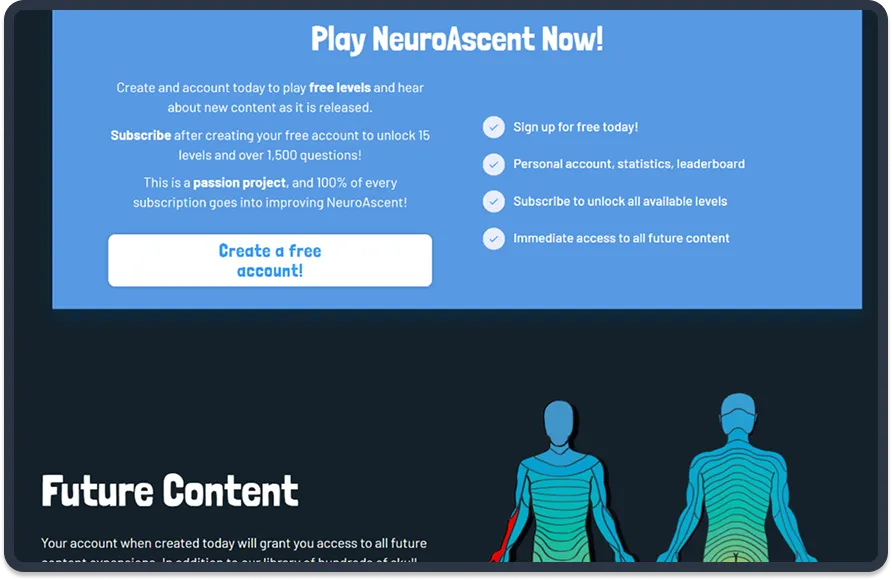
The platform operates on a freemium model, allowing students to access introductory content for free while unlocking premium anatomy content through subscription access.

The subscription infrastructure supports:

  • Free-tier onboarding
  • Premium content access
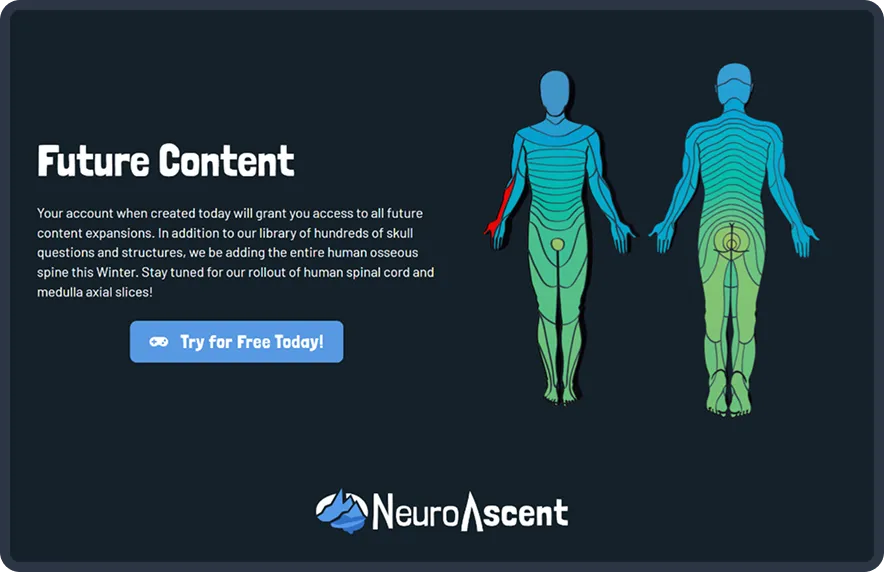
  • Future content expansion
  • Sustainable platform growth

The Modern Stack Behind the Software.

A modern, production-ready stack was selected to support real-time interactions, cross-platform mobile delivery, and scalable deployment.

Core Technologies
React.js
Three.js
Progressive Web App (PWA)
Python 3.8
Django Framework
Celery
Redis
MySQL
Supporting Infrastructure & Services
Docker
Docker Compose
WebGL Rendering
REST APIs
Redis Caching Layer
Asynchronous Background Processing

See NeuroAscent in Action

NeuroAscent is now live and accessible globally through modern web browsers and Progressive Web App installation.

Project Timeline

Approximately 12+ months of phased feature development and platform expansion

Project Inheritance & Architecture Assessment

Canadian Software Agency inherited the existing NeuroAscent platform and conducted a complete assessment of the frontend architecture, backend services, gameplay systems, and learning algorithms.

Initial planning focused on expanding the platform beyond its original single-mode learning experience.

Core Gameplay Expansion

Development began on major gameplay and engagement systems, including:

  • Timed Mode gameplay
  • Leaderboard architecture
  • Achievement systems
  • Expanded educational workflows
  • Enhanced statistics tracking

Interactive Learning & Gamification Features

The platform was expanded with:

  • Educational tooltip systems
  • Competitive ranking infrastructure
  • User reporting systems
  • Gamified progression mechanics
  • Enhanced user engagement workflows

3D Learning & PWA Optimisation

Canadian Software Agency refined:

  • Three.js anatomical rendering
  • Cross-device compatibility
  • Progressive Web App installation support
  • Mobile responsiveness
  • Performance optimisation

Content Expansion & Platform Growth

The platform continues to evolve with:

  • Additional anatomy content
  • New question libraries
  • Expanded neuroanatomy coverage
  • Improved educational workflows
  • Ongoing feature enhancements

Expanded Into a Comprehensive Medical Learning Ecosystem

NeuroAscent successfully evolved from a single-mode anatomy revision tool into a scalable, multi-mode educational platform serving healthcare students globally.

The engagement delivered:

  • Cross-device anatomy learning accessibility
  • Interactive 3D educational experiences
  • Competitive study environments
  • Scalable educational infrastructure
  • Gamified retention-focused learning systems

Key Outcomes

Initial planning focused on expanding the platform beyond its original single-mode learning experience.

Expert-reviewed anatomy questions
0 +
Anatomical structures covered
0 +
Freemium subscription infrastructure integrated
0
Scalable Docker-based architecture delivered
0 %
Cross-platform browser accessibility achieved
0 %

Related Case Studies

Frequently Asked Questions

Yes, we build interactive learning platforms with quizzes, achievements, leaderboards, progress tracking, and reward systems to improve learner engagement.

Yes, we develop adaptive learning algorithms that adjust question frequency based on user performance to support long-term knowledge retention.
Yes, we use technologies such as Three.js and WebGL to create browser-based 3D visualizations that help users explore complex subjects interactively.
Yes, we develop Progressive Web Apps that work across desktop and mobile browsers and can be installed on compatible devices for an app-like experience.
Yes, we improve existing applications by adding new learning features, optimizing performance, strengthening infrastructure, and enhancing user experience without rebuilding everything from scratch.

Ready to work together?

Let's get in touch