


Mobile apps are now a key part of business growth. Customers use apps to shop, book, pay, track orders, and get support. Teams also use apps to manage work, share updates, and improve daily tasks. That is why many leaders want to Build Successful Mobile Apps that create real value.
But a good app is not just about code. It must solve a real problem. It must be easy to use. It must support business goals. It also needs a clear plan for growth, cost, and return on investment.
In this guide, we explain how businesses can Build Successful Mobile Apps step by step. You will learn how to plan your app, choose the right features, improve user experience, reduce risk, and measure results. We will also cover mobile app development for businesses, business mobile app strategy, mobile app design best practices, the app development process, and mobile app monetization strategies. If you are a founder, CTO, product manager, or operations leader, this guide is for you.
What Does It Mean to Build Successful Mobile Apps?
To Build Successful Mobile Apps means creating apps that solve a user problem, support business goals, and deliver results over time.
For businesses, success often means:
- More sales
- Better retention
- Lower costs
- Faster operations
- Better customer service
- Stronger brand loyalty
When companies Build Successful Mobile Apps, they focus on value first. They do not build apps just to follow trends.
Start With a Clear Business Mobile App Strategy
If you want to Build Successful Mobile Apps, start with a strategy. Do not start with screens or features.
Ask these questions first:
- What problem will the app solve?
- Who will use it?
- Why does this need to be mobile?
- What business result do we want?
- How will we measure success?
This is the base of a strong business mobile app strategy.
Connect the app to business goals
Every app should support a goal. For example:
- Increase sales
- Improve customer loyalty
- Reduce manual work
- Speed up service
- Improve team communication
Businesses Build Successful Mobile Apps when they tie features to clear business goals.
Validate the Idea Before You Build
Many teams move too fast. They spend money before they test the idea. That creates risk.
Before you Build Successful Mobile Apps, validate the idea first.
Simple ways to validate
Use these methods:
- Customer interviews
- Short surveys
- Competitor research
- Landing pages
- Clickable prototypes
- Small pilot launches
These steps help you learn what users really want.
MVP
An MVP is the first version of an app with only the core features needed to test the idea. An MVP helps businesses Build Successful Mobile Apps with less risk. It also helps teams learn faster.
Focus on the Right Features
One of the biggest mistakes in mobile app development for businesses is adding too many features.
More features do not always mean more value.
To Build Successful Mobile Apps, start small and focus on what matters most.
Prioritize features in three groups
Use this simple model:
- Must-have
- Nice-to-have
- Later
Your first release should focus on must-have features only.
Examples of useful early features:
- Sign in
- User profile
- Search
- Booking or ordering
- Payments
- Notifications
- Support
- Dashboard
This keeps the app clear and useful.
Solve one main problem first
The best custom mobile app solutions often start with one main use case.
For example:
- A delivery app may focus on live tracking
- A health app may focus on booking visits
- A SaaS app may focus on alerts and reports
- A retail app may focus on easy checkout
This helps teams Build Successful Mobile Apps that users actually keep using.
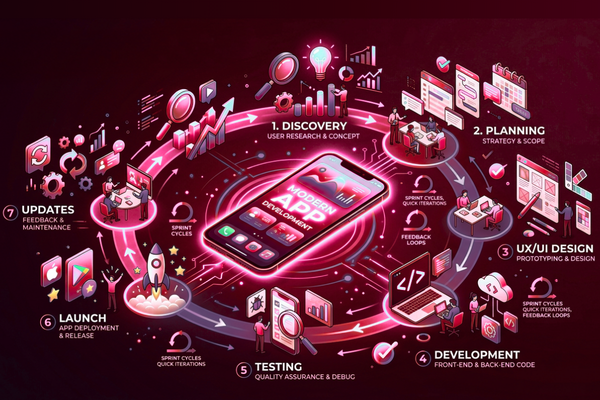
Follow a Clear App Development Process
A strong app development process helps teams stay on time and on budget.
App development process
The app development process is the step-by-step path from planning to launch and improvement.
A simple mobile app development guide often includes:
- Discovery
- Planning
- UX and UI design
- Development
- Testing
- Launch
- Updates and support
If you want to Build Successful Mobile Apps, use a process that gives clear milestones and regular feedback.
Use short delivery cycles
Agile delivery works well for many teams. It breaks work into smaller parts.
Benefits include:
- Faster feedback
- Better control
- Easier updates
- Lower risk
- Better alignment with business needs
This is one of the smartest ways to Build Successful Mobile Apps in changing markets.
Use Mobile App Design Best Practices
Design is not just about looks. It affects how people use the app. It also affects trust, conversion, and retention.
To Build Successful Mobile Apps, use a clear and simple design.
Key mobile app design best practices
Follow these rules:
- Keep navigation simple
- Use clear labels
- Reduce the number of steps
- Make buttons easy to tap
- Use readable text
- Keep screens clean
- Make onboarding easy
- Show clear calls to action
These mobile app design best practices help users complete tasks faster.
Mobile app user experience (UX) matters
Mobile app user experience (UX) is how easy and useful the app feels for real users.
Good mobile app user experience (UX) leads to:
- Better conversion
- Higher retention
- Fewer support requests
- Better reviews
- More repeated use
Companies Build Successful Mobile Apps when they test UX early and improve it often.
Choose the Right Technology
Option |
Best For |
Speed |
Cost |
Performance |
Native |
High-performance apps |
Medium |
High |
Excellent |
Cross-platfom |
Faster business app delivery |
Fast |
Medium |
Good |
Hybrid |
Simple apps and prototypes |
Very fast |
Low |
Moderate |
There is no single best way to build every app. The right choice depends on your goals, budget, and timeline.
To Build Successful Mobile Apps, choose technology based on business needs.
Common options
Native apps
Best for:
- High performance
- Advanced features
- Better device support
Cross-platform apps
Best for:
- Faster delivery
- Lower cost
- One shared codebase
Hybrid apps
Best for:
- Simple apps
- Early testing
Each option has trade-offs. The best choice depends on your product.
If your roadmap includes AI features, these resources can help:
Build for Security and Scale
Security is a business issue, not just a technical one. If users do not trust the app, they will not use it.
To Build Successful Mobile Apps, plan for security from the start.
Important areas to cover
Make sure your app includes:
- Secure login
- Data encryption
- Access control
- Safe APIs
- Privacy protection
- Monitoring
- Backup and recovery
This is very important in finance, healthcare, education, and enterprise software.
Plan for growth
Your app may start small. But success can bring more users, more data, and more feature needs.
Businesses Build Successful Mobile Apps when they plan for:
- More users
- More traffic
- New features
- New regions
- Better uptime
Good architecture supports long-term growth.
Plan Revenue and ROI Early
A mobile app should support business value. That value can be direct revenue or better efficiency.
Before you Build Successful Mobile Apps, decide how the app will create a return.
Common mobile app monetization strategies
Popular mobile app monetization strategies include:
- Subscription plans
- In-app purchases
- Transaction fees
- Paid premium features
- Ads
- Service upsells
- Enterprise pricing
The right model depends on your business type and user needs.
Track ROI with clear metrics
To measure success, track:
- Downloads
- Active users
- Conversion rate
- Revenue per user
- Retention rate
- Churn rate
- Support cost savings
- Time saved in operations
Companies Build Successful Mobile Apps more effectively when they measure results from the start.
Test Before and After Launch
Testing is one of the most useful and successful app development tips.
Do not wait until the end.
To Build Successful Mobile Apps, test throughout the project.
What to test before launch
Check these areas:
- Main user flows
- Device compatibility
- Speed
- Login and security
- Payments
- Notifications
- Error messages
- Accessibility
What to test after launch
After launch, watch for:
- User drop-off
- Low-use features
- Crashes
- Bad reviews
- Slow screens
- Support issues
User acceptance testing
User acceptance testing is when real users or business stakeholders test the app to confirm it works in real situations.
This is a key step in building a mobile app that performs well in the real world.
Keep Improving After Launch
Launch is not the finish line. It is the start of the next phase.
The best teams Build Successful Mobile Apps by learning from real user behavior.
Track the right data
Watch these KPIs:
- Installs
- Daily users
- Session time
- Feature use
- Conversion
- Retention
- Crash rate
- Ratings
This helps you decide what to improve next.
Listen to feedback
Use feedback from:
- In-app surveys
- Support teams
- Sales teams
- Analytics tools
- User interviews
- App store reviews
This helps businesses Build Successful Mobile Apps that stay useful over time.
Learn From Real Product Work
Business leaders often want to see how product strategy works in real projects.
We have supported digital product delivery across different use cases. You can explore selected work here:
These examples show how focused planning and smart execution help teams Build Successful Mobile Apps and other digital products.
Common Mistakes to Avoid
Even strong teams make avoidable mistakes.
Here are common problems that stop companies from trying to Build Successful Mobile Apps the right way:
1. No clear goal
Without a goal, it is hard to choose features or measure success.
2. Too many features
Large first releases often delay launch and confuse users.
3. Poor UX
If the app feels hard to use, users leave quickly.
4. Weak testing
Small bugs can create major trust issues.
5. No post-launch plan
Apps need updates, support, and measurement after release.
These are simple but important successful app development tips for any business leader.
Why Businesses Choose CSA
At Canadian Software Agency, we help companies Build Successful Mobile Apps with a clear focus on value, usability, and growth.
We support startups, SaaS companies, and enterprise teams with:
- Product discovery
- Planning and roadmap work
- Custom mobile app solutions
- Design and UX support
- Development and testing
- Launch support
- Ongoing improvements
Whether you are learning to build a mobile app or upgrading an existing product, our team can help you move forward with greater clarity and less risk.
Ready to Build Successful Mobile Apps?
If your company is planning a new mobile app, we can help you Build Successful Mobile Apps with a smart strategy and practical execution.
Contact Canadian Software Agency today to validate your idea, define your roadmap, and launch an app that supports real business results.

Conclusion
To Build Successful Mobile Apps, businesses need a clear strategy, the right features, a simple design, strong testing, and ongoing improvement. The best apps solve real problems and support real business goals. Companies that Build Successful Mobile Apps focus on users, ROI, and long-term value. If you need a trusted partner to Build Successful Mobile Apps, we are ready to help. To get a free estimate, visit our website here.
FAQs
How do businesses start mobile app development?
Start with strategy. Define the problem, target users, business goals, and MVP features before development begins.
What is the best way to build a mobile app?
The best approach is to validate the idea, start with core features, use a clear process, and test often.
How long does it take to build a business mobile app?
A simple MVP may take a few months. A larger app with more features and integrations will take longer.
What are common mobile app monetization strategies?
Common models include subscriptions, in-app purchases, transaction fees, paid features, and ads.
Why is UX important in mobile apps?
A good mobile app user experience (UX) makes it easy for users to complete tasks. That improves retention, conversion, and satisfaction.