
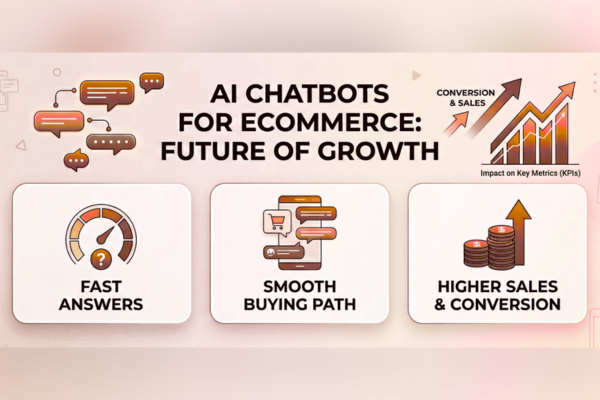
Online shoppers want fast answers. They want help now, not tomorrow. And they want a smooth buying path on the web and mobile. That is why AI Chatbots for Ecommerce are becoming a core growth tool for modern brands. They do more than “support.” They guide buyers, reduce drop-offs, and help teams sell more with less manual work.
For ecommerce leaders, the business value is clear. A well-built chatbot can lower support load, improve conversion, and lift customer lifetime value. It can also keep service consistent during peak traffic, new product drops, and holiday sales. In this blog, we will break down what ecommerce chatbot solutions are, where they drive the most impact, how to plan costs, and what a smart rollout looks like for web and mobile apps. You will also get practical use cases, tables, KPIs, and a clear next step to launch.
Why AI Chatbots for Ecommerce are becoming the growth engine
Ecommerce chatbot solutions are automated chat assistants that use AI to answer questions, guide shoppers, and complete support tasks across an online store (web, mobile app, and messaging). They can pull from product data, policies, and order systems to give fast, accurate help.
Many brands first adopt bots for ecommerce customer support. But the bigger win is revenue growth through conversational commerce. When chat becomes a sales channel, support and sales start working as one.
What makes them different from old chatbots?
- They understand intent better.
- They handle longer, more natural questions.
- They can connect to real store data (orders, SKUs, inventory).
- They improve over time with feedback and training.
Where do they fit in a mobile-first strategy
- In-app chat reduces friction for repeat buyers.
- Push + chat can recover buyers at the right moment.
- A consistent omnichannel experience builds trust.
What shoppers expect now (and why speed wins)
Shoppers compare your store to the best experience they have had anywhere. That might be a marketplace app. Or a global brand with 24/7 help. If your response time is slow, they leave.
Today’s expectations are simple:
- Instant answers on product fit, shipping, and returns
- Clear help during checkout
- Fast order tracking without waiting for an agent
- A smooth handoff to a human when needed
When you use ecommerce chatbot solutions, you meet these expectations at scale.
Common “friction moments” that chatbots can remove
- “Is this in stock in my size?”
- “When will it arrive?”
- “Can I return it?”
- “Do you have a discount?”
- “Why did my payment fail?”
This is also where checkout optimization starts. Not on a redesign. But by removing confusion in the moment.
Key use cases across the ecommerce funnel
Ecommerce chatbot solutions deliver the most value when they support the full journey, not just tickets.
Pre-purchase: help shoppers choose faster
Use the chatbot to:
- Answer product questions
- Compare items
- Share size guides
- Explain warranties and policies
- Offer product recommendations based on needs and budget
Good outcomes
- More add-to-cart actions
- Higher confidence
- Better first-time conversion
During purchase: reduce drop-offs
The checkout stage is where revenue is won or lost. Chatbots can:
- Explain shipping options
- Clarify taxes and duties
- Help apply promo codes
- Fix common payment confusion
- Support checkout optimization with real-time guidance
This directly targets shopping cart abandonment.
Post-purchase: keep service fast and consistent
After the sale, shoppers still need help. A bot can handle:
- Order tracking
- Address changes (when allowed)
- Return and exchange steps
- Refund timelines
- Warranty claims
This supports customer retention because good service is remembered.
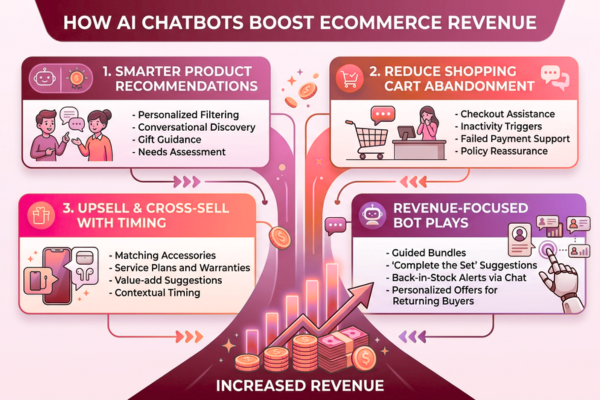
How AI Chatbots for Ecommerce increase revenue (not just reduce tickets)
Cost savings matter. But ecommerce growth teams care about revenue. A well-planned bot can drive sales in clear ways.
1) Smarter product recommendations
Instead of static “related products,” chat can ask short questions:
- “Who is this for?”
- “What is your budget?”
- “Do you prefer A or B?”
Then it suggests a short list. This is personalized marketing inside the buying moment.
2) Reduce shopping cart abandonment
Bots can trigger when:
- A shopper stays too long at checkout
- A cart is left open
- A buyer returns after a failed payment
They can offer:
- Quick answers to common concerns
- Delivery estimates
- Returns reassurance
- Optional incentives (used carefully)
3) Upsell and cross-sell with timing
Upsells work best when they feel helpful. For example:
- “Want a matching case with that phone?”
- “Add gift wrap?”
- “Protective plan?”
This is where conversational commerce becomes a real revenue channel.
Revenue-focused bot plays
- Guided bundles
- “Complete the set” suggestions
- Back-in-stock alerts via chat
- Personalized offers for returning buyers
Business value: cost savings, speed, and accuracy
This is the part many teams miss: Ecommerce chatbot solutions are also an operations tool. They reduce repeat work across support, sales, and ops.
Benefits of AI automation include:
- reduced operational costs
- faster workflows
- improved accuracy
Where the savings show up
- Fewer repetitive tickets (order status, return steps)
- Shorter time-to-first-response
- Better routing to the right human team
- Less copy/paste work for agents
Other business gains
- Stronger lead generation from high-intent chats
- Higher customer retention from fast support
- Better data on what customers ask (great for product and UX teams)
If you already invest in mobile apps, chat can also reduce in-app support friction. It keeps buyers in the app instead of pushing them to email.
Features that matter most (Feature → Benefit)
Not all bots are equal. The best Ecommerce chatbot solutions connect to your real store systems and follow your brand rules.
Feature | Benefit table
| Feature | Benefit |
| Product catalog sync | Accurate answers on variants, pricing, and availability |
| Intent detection | Better understanding of what shoppers mean |
| Human handoff | Smooth escalation for complex cases |
| Order system integration | Fast order tracking and status updates |
| Multilingual support | Better conversion in global markets |
| Analytics dashboard | Track ROI, drop-offs, and top questions |
| Safe response rules | Reduces risk from wrong or off-brand answers |
Tip: If your store changes often (inventory, promos, shipping rules), prioritize integrations. That is how you keep answers correct and protect trust.
Trust, brand voice, and safe AI use
Trust drives conversion. A chatbot that sounds wrong, guesses, or overpromises can hurt sales.
How to keep chat safe and on-brand
- Use clear “allowed answers” for returns, refunds, and shipping
- Show sources (order status, policy links) when possible
- Add a “confirm before action” step for sensitive requests
- Log chats for quality review (with privacy controls)
Privacy and compliance basics
- Collect only what you need
- Mask sensitive data in logs
- Use clear consent language for marketing follow-ups
Many teams also choose proven AI platforms. For example, solutions built with OpenAI tools can support strong language understanding, while Google AI options can fit teams already invested in Google’s cloud stack.
The main point: choose the model and setup that fits your data, risk level, and brand tone.
Omnichannel + mobile: where chat drives the biggest lift
Shoppers do not stay in one place. They browse on mobile, compare on desktop, then ask questions on social. Your bot should support a full omnichannel experience.
High-impact channels
- Website chat for first-time visitors
- In-app chat for repeat buyers (lower friction)
- Email and SMS links that open a chat session
- Messaging apps (based on your market)
Why mobile app chat is a growth lever
- One-tap access inside the buying flow
- Persistent identity for personalization
- Stronger customer retention through better service
In marketplace-style builds, chat can also support two-sided flows (buyers and sellers). For example, product discovery and guided flows are common patterns in modern apps like this Hoopfind marketplace app project, where smooth user journeys matter.
Cost planning: SaaS vs custom builds
Cost depends on your goals. A simple FAQ bot costs less. A full commerce assistant that connects to orders, CRM, and catalog costs more.
AI Development Type | Estimated Cost
| AI Development Type | Estimated Cost |
| AI Chatbot | $10k – $50k |
| AI SaaS | $50k – $200k |
| Enterprise AI | $100k+ |
How to choose the right path
- Choose SaaS when you need speed and standard flows.
- Choose custom when you need deep integrations, brand control, and unique workflows.
- Choose enterprise when you need advanced governance, multi-team routing, and complex data rules.
For brands that want a deeper AI strategy and implementation, our team often starts from an AI roadmap and then builds the right solution through our AI services for product and ecommerce teams.
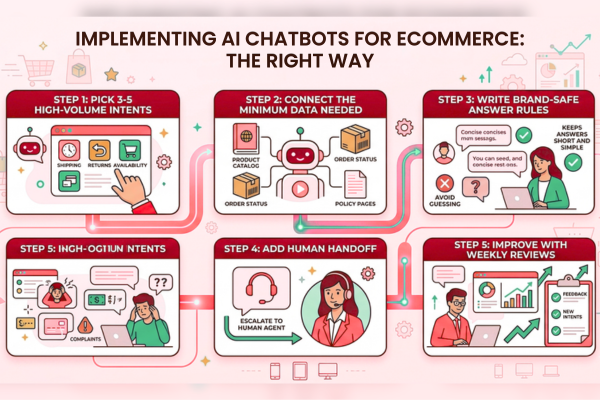
How to implement ecommerce chatbot solutions the right way
A chatbot should not be a “big bang” launch. Start small. Prove value. Expand.
Step 1: Pick 3–5 high-volume intents
Good first impressions:
- Shipping times
- Return steps
- Order tracking
- Product availability
- Promo code help
Step 2: Connect the minimum data needed
Focus on:
- Product catalog
- Order status
- Policy pages
- Support ticket system (optional at first)
Step 3: Write brand-safe answer rules
Keep answers short. Use simple words. Avoid guessing.
Step 4: Add human handoff
Define when to escalate:
- High-order value customers
- Payment issues
- Complaints and negative sentiment
- Complex address or delivery issues
Step 5: Improve with weekly reviews
Use chat logs to:
- Fix wrong answers
- Add new intents
- Improve product recommendations
In real ecommerce builds, sustainable growth often comes from small improvements done consistently. That same approach shows up in product-focused case studies like this GreenTag digital product build, where user experience and clarity drive adoption.
KPIs that prove ROI (and keep the project on track)
To show real value, track metrics that map to money and time.
Support and ops KPIs
- Ticket deflection rate
- First response time
- Average handling time (for human agents)
- Cost per resolution
- CSAT after chat
Revenue and growth KPIs
- Conversion rate for chat users vs non-chat users
- Revenue influenced by chat
- Reduced shopping cart abandonment
- Increase in AOV from guided upsells
- Repeat purchase rate (customer retention)
Marketing and funnel KPIs
- Qualified leads captured (lead generation)
- Opt-ins for follow-up messages
- Performance by segment (new vs returning)
A strong rule: if you cannot measure it, you cannot improve it.
Start Your AI Development Project
If you want AI Chatbots for Ecommerce that do more than answer FAQs, you need a plan that fits your store, your mobile app, and your customer journey. The right chatbot can reduce costs, improve conversion, and deliver a smoother experience across every channel.
Start Your AI Development Project
If your company is exploring AI solutions, our team at Canadian Software Agency can help you design and build scalable AI platforms that support ecommerce growth without adding complexity for your teams. We focus on practical builds: clear scope, clean UX, and measurable ROI.
If you want a realistic budget based on your store, app, and integrations, it helps to map scope early. Many teams start with a quick planning pass using a structured project estimate for AI development so the build aligns with real business priorities.
Conclusion
Ecommerce is getting more competitive, not less. Shoppers expect instant answers, personalized help, and fast service. Brands that deliver that experience will win more sales and keep more customers.
AI Chatbots for Ecommerce are one of the most direct ways to improve the buying journey. They support conversational commerce, reduce shopping cart abandonment, improve product recommendations, and scale ecommerce customer support without scaling costs at the same rate. If you start with the right use cases, track the right KPIs, and expand based on results, chat becomes a lasting growth channel on web and mobile.
FAQs
1) How long does it take to launch Ecommerce chatbot solutions?
A basic version can launch in 3–6 weeks. A deeper build with catalog and order integrations often takes 6–12+ weeks, depending on systems and testing needs.
2) Will a chatbot replace my support team?
No. The best approach is “AI + humans.” The bot handles repetitive questions. Humans handle edge cases, complex issues, and high-value customers.
3) Can chatbots really reduce shopping cart abandonment?
Yes, when they address checkout confusion in the moment. The biggest wins come from shipping clarity, returns reassurance, and payment help.
4) What data do I need for better product recommendations?
At minimum: product catalog data, key attributes (size, color, category), and basic user intent from chat. More advanced setups can use browsing behavior and purchase history (with consent).
5) Where should I deploy first: website or mobile app?
Start where your traffic and drop-offs are highest. Many brands start on the website for speed, then add in-app chat to strengthen customer retention.