SaaS is one of the fastest ways to turn an idea into recurring revenue. Instead of selling once, you build a product that customers pay for every month.
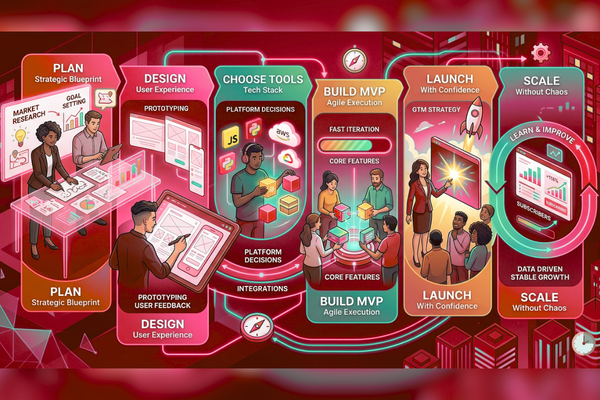
For business leaders, the value is simple. A SaaS product can reduce manual work, improve customer experience, and open new markets without adding the same cost each time you add a new customer. For product teams, it creates a clear cycle: research → build → launch → learn → improve.
This guide breaks SaaS software development into simple steps you can follow. You will learn how to plan your product, design it, choose tools, build an MVP, launch with confidence, and scale without chaos. You will also see real tables, checklists, and decision points you can reuse with your team.
If you are a mobile app development company (or hiring one), this matters even more. Many SaaS products need a mobile app to drive daily use, improve retention, and support field teams.
What is SaaS product development?
SaaS software development is the process of building, launching, and scaling a subscription-based software product that users access online.
A SaaS product is not “done” after release. It grows over time with updates, new features, security fixes, and performance improvements.
What makes SaaS different from normal software?
- You manage one product for many customers
- You deploy updates often
- You must protect customer data
- You track usage and improve based on real behavior
SaaS MVP development is the fastest way to release a working first version with only the core features needed to prove demand and reduce risk.
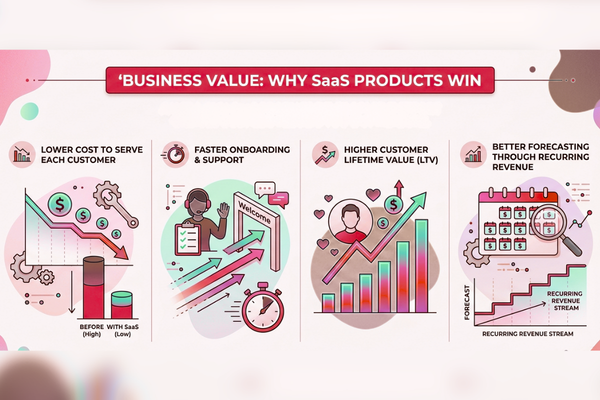
Business value: why SaaS products win
A well-run SaaS software development effort creates business results you can measure.
Key SaaS metrics that improve with strong product development
- Lower cost to serve each customer
- Faster onboarding and support
- Higher customer lifetime value (LTV)
- Better forecasting through recurring revenue
Where AI automation fits (simple, real value)
Many SaaS teams add AI to reduce busywork and speed up service.
Benefits of AI automation include:
- reduced operational costs
- faster workflows
- improved accuracy
- better self‑service support
- quicker search and insights inside the app
Start with SaaS product strategy (before you build)
A strong SaaS product strategy keeps you from building features that do not sell.
Quick strategy checklist
- Who is the buyer? (owner, manager, team lead)
- What problem is urgent? (cost, time, compliance, risk)
- What do they do today? (spreadsheets, email, legacy tools)
- Why now? (new rules, growth, staffing limits, market shift)
Define your “must-win” use case
Pick one high‑value workflow. Make it smooth. Make it reliable. Then expand.
Good SaaS products often start with:
- scheduling and dispatch
- inventory and field reporting
- Team collaboration and approvals
- customer portals and payments
Build a SaaS product roadmap that stays realistic
A SaaS product roadmap should be clear, short, and flexible. It is not a wish list.
Roadmap structure that works
Use three simple horizons:
- Now (0–6 weeks): MVP scope, design, core build
- Next (2–3 months): onboarding, billing, analytics, key integrations
- Later (3–12 months): advanced automation, new roles, new markets
What to include in the roadmap
- outcomes (reduce churn, improve activation)
- assumptions (what must be true for success)
- metrics (trial-to-paid, retention, support tickets)
If you want a fast way to plan a budget and timeline, you can get a project estimate for your SaaS build and align your roadmap to real delivery phases.
SaaS product design process: make it simple for users
A strong SaaS product design process is not about fancy screens. It is about reducing confusion.
Design goals that improve revenue
- Users finish tasks fast
- fewer support requests
- smoother onboarding
- better retention after week one
A simple design flow
- Map the main user journey (sign up → first value)
- Sketch 3–5 key screens
- Build a clickable prototype
- Test with 5–7 real users
- Improve, then build
Feature–Benefit table (useful for prioritization)
| Feature | Business Benefit |
| Guided onboarding | Higher activation and fewer drop-offs |
| Role-based access | Better security and clearer workflows |
| In-app notifications | Faster task completion |
| Self-serve billing | Lower support load |
| Audit logs | Easier compliance and trust |
When teams skip design, SaaS software development slows down later due to rework.
SaaS tech stack selection: reduce risk, not just cost
SaaS tech stack selection is a business decision. The wrong choice increases delays, hiring cost, and outages.
What to optimize for
- speed to ship MVP
- stability and security
- ability to scale
- ease of hiring developers
Typical SaaS stack layers (plain language)
- Front end: web app + optional mobile app
- Back end: APIs and business logic
- Database: stores user and product data
- Cloud: hosting and scaling
- Analytics: product usage tracking
- Payments: subscriptions and invoices
Authority references (for AI-enabled SaaS)
If you plan AI features, start with trusted platforms:
- OpenAI platform overview
- Google Cloud AI products
These can speed up SaaS software development when used for clear, narrow tasks (search, chat, summarization), not vague “AI everywhere.”
Scalable SaaS architecture: build for growth without overbuilding
A scalable SaaS architecture should handle more users without breaking. But it should also stay simple early on.
Practical architecture principles
- Keep the first version small
- Separate core modules (auth, billing, reporting)
- Log key events (signups, upgrades, failures)
- Plan for backups and recovery
Real-world scaling concerns
- slow dashboards as data grows
- long load times on mobile networks
- background jobs failing silently
- messy permission rules
A good team treats reliability as part of SaaS software development, not an “extra” for later.
SaaS development steps: from SaaS MVP development to V1
Teams move faster when they follow clear SaaS development steps.
A simple end-to-end build plan
- Confirm problem, buyer, and pricing hypothesis
- Define MVP scope (core workflow only)
- Design prototype and validate with users
- Build MVP with analytics from day one
- Test security, performance, and edge cases
- Launch to a small group
- Improve onboarding and fix friction
- Expand features based on real usage
What “MVP” should include (most SaaS products)
- sign up + login
- one clear “main job” screen
- Basic admin panel
- error handling and support contact
- analytics events (activation + retention)
If you want proof that steady delivery matters, look at how structured execution supports complex builds like this Phantom Disposal project delivery, where clear phases and real user needs drive outcomes.
SaaS business model explained: pricing that supports growth
A strong product can still fail with weak pricing. A clear SaaS business model explained helps teams align product, sales, and support.
Common SaaS pricing models
- Per user: simple to understand, good for team tools
- Usage-based: fair for variable consumption
- Tiered plans: best for upsells and packaging
Simple packaging rule
Make plans based on:
- Who the plan is for
- What problem does it solve
- What limits apply (users, projects, storage)
Pricing is part of SaaS software development because it shapes which features matter most.
SaaS launch strategy: release with confidence
A SaaS launch strategy should reduce risk and create learning.
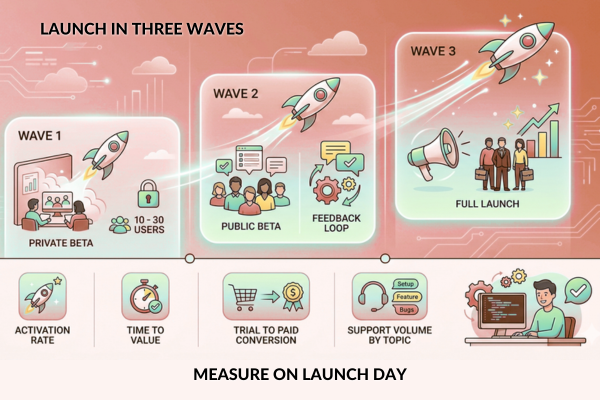
Launch in three waves
- Wave 1: Private beta (10–30 users)
- Wave 2: Public beta (bigger audience, clear feedback loop)
- Wave 3: Full launch (marketing + sales push)
What to measure on launch day
- activation rate (users reach first value)
- time to first value
- trial-to-paid conversion
- support volume by topic
A clean launch makes SaaS software development easier after release because you know what to fix first.
SaaS growth and scaling: what to improve first
SaaS growth and scaling are not only about ads. It is mostly about product experience.
The highest-impact growth levers
- better onboarding
- fewer bugs in key workflows
- faster app performance
- clearer pricing pages
- improved retention emails and in-app prompts
Add a mobile to increase daily use
Many SaaS products grow faster when users can act from anywhere.
For example, marketplaces and service platforms often need mobile-first execution. Projects like this Kangrooo build show how mobile experience can support adoption and repeat usage.
Scaling is a loop:
- measure → improve → ship → measure again
That loop is the heart of SaaS software development.
Cost planning (including AI): a simple table you can reuse
Costs change based on scope, integrations, and timeline. AI features also affect the budget.
Here is a simple reference table:
| AI Development Type | Estimated Cost |
| AI Chatbot | $10k – $50k |
| AI SaaS | $50k – $200k |
| Enterprise AI | $100k+ |
Use this only as a starting point. The real number depends on:
- data quality
- security needs
- accuracy targets
- user volume
For complex systems, SaaS software development cost is mostly driven by product scope and long-term support needs.
Start Your AI Development Project
If your company is planning a new SaaS build or adding AI features, our team at Canadian Software Agency can help you plan, design, and deliver a product that is stable, secure, and ready to scale.
You can start by exploring our AI services for modern SaaS products, then align the scope and budget using a clear plan and timeline. If you already have requirements, you can request a project estimate to move from ideas to action.
Conclusion
SaaS product development becomes “simple” when you stop trying to do everything at once. The winning approach is to focus on one urgent customer problem, ship a clear MVP, and improve based on real usage. That sounds basic, but it is exactly what most teams skip. They overbuild, delay launch, and learn too late.
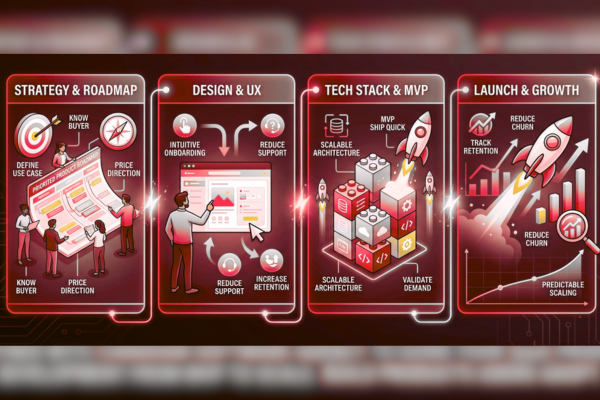
Start with a clear SaaS product strategy. Know your buyer, your use case, and your pricing direction. Then build a realistic SaaS product roadmap that protects the team from scope creep. Strong design matters too. A clean SaaS product design process improves onboarding, reduces support, and increases retention. It is one of the best ROI moves you can make.
Next, make smart choices in SaaS tech stack selection. Choose tools your team can ship with and support for years. Pair that with a scalable SaaS architecture that is reliable without being overcomplicated. Then follow clear SaaS development steps, using SaaS MVP development to validate demand before you invest in advanced features.
Finally, plan a practical SaaS launch strategy and treat release as the start of learning, not the finish line. Track activation, retention, and churn. Improve what blocks customers from getting value. That is how SaaS growth and scaling become predictable.
If you want a partner to guide your next SaaS software development cycle from MVP to scale, Canadian Software Agency can help you build a product that users adopt, teams trust, and businesses can grow.
FAQs
1) How long does SaaS software development take?
A focused MVP often takes 8–16 weeks. A stronger V1 with billing, roles, analytics, and key integrations often takes 4–6 months.
2) What is the biggest mistake in SaaS MVP development?
Building too many features before proving the core workflow. MVP success is about learning fast, not shipping big.
3) How do I choose the right SaaS tech stack selection approach?
Choose tools that match your team’s skills, speed up delivery, and reduce long-term support risk. Avoid trendy tools that are hard to hire for.
4) What should be included in a SaaS launch strategy?
A staged rollout (private beta → public beta → full launch), clear success metrics, and a tight feedback loop to fix adoption blockers.
5) When should I focus on SaaS growth and scaling?
After you see consistent activation and early retention. Scaling before product-market fit usually increases costs without improving revenue.