
Choosing the right platform can make or break your online business. The debate of WordPress vs. Shopify is one of the most common questions business owners face today. Both platforms power millions of websites around the world. But they serve very different needs. WordPress started as a simple blogging tool. It has grown into a full website builder. Shopify was built from day one for selling products online. Your choice depends on your goals, your budget, and your team’s skills. In this guide, we break down every key factor. We cover ease of use, design, costs, SEO, security, and more. By the end, you will know which platform fits your business best. Whether you run a small shop or a large brand, this comparison will help you decide with confidence. Let us dive into the details.
What Is WordPress?
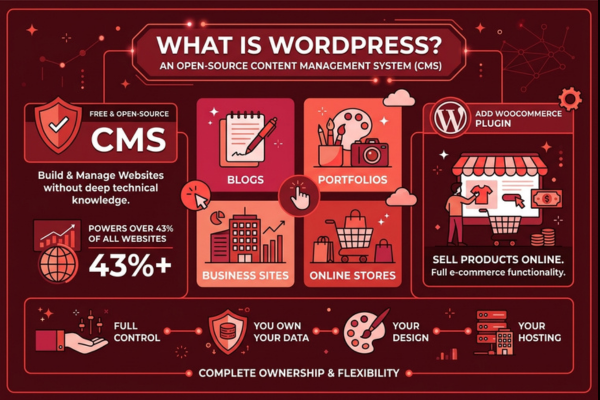
WordPress is a free, open-source content management system (CMS) that allows users to build and manage websites without deep technical knowledge. It powers over 43% of all websites on the internet.
You can build blogs, portfolios, business sites, and online stores with it. To sell products, you add a plugin called WooCommerce. This gives you full control over every part of your site. You own your data, your design, and your hosting. WordPress is ideal for businesses that want total flexibility. Learn more at the official WordPress.org website.
What Is Shopify?
Shopify is a subscription-based e-commerce platform that provides all the tools needed to create and manage an online store, including hosting, payments, and security.
It lets you create an online store without any coding skills. Shopify handles hosting, security, and payments for you. You just pick a theme, add your products, and start selling. It is built for merchants who want a fast and simple setup. Visit Shopify.com for official details. Shopify is perfect for businesses focused purely on selling products online.
WordPress vs Shopify: Ease of Use
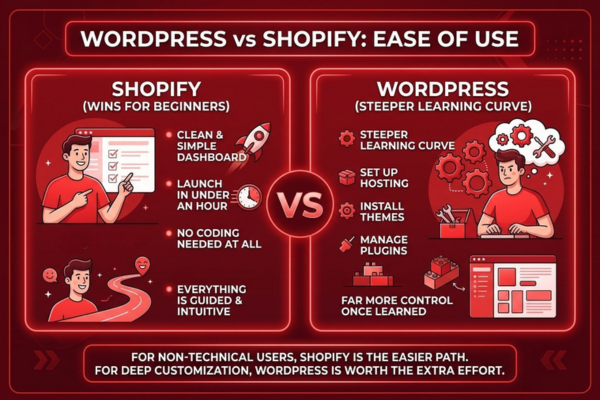
Shopify wins for beginners. Its dashboard is clean and simple. You can launch a store in under an hour. No coding is needed at all. Everything is guided and intuitive.
WordPress has a steeper learning curve. You need to set up hosting, install themes, and manage plugins. But once you learn the basics, it offers far more control over your site.
For non-technical users, Shopify is the easier path. For those who want deep customization, WordPress is worth the extra effort. Many businesses choose to work with experts for professional WordPress development to skip the learning curve entirely and launch faster.
Design and Customization Options
When comparing WordPress vs Shopify for design, WordPress gives you unmatched freedom. You can choose from thousands of free and premium themes. You can also build a custom design from scratch. Every color, font, and layout is fully editable.
Shopify offers around 200 themes. Most are modern and mobile-friendly. But your design choices are more limited. Big changes often require knowledge of Shopify’s Liquid code.
Key design differences include:
- WordPress supports unlimited theme options
- Shopify themes are polished but fewer in number
- WordPress allows full code access
- Shopify restricts backend customization
- WordPress works with page builders like Elementor
- Shopify relies on its own drag-and-drop editor
If your brand needs a unique look, WordPress is the stronger choice. For a clean, ready-made storefront, Shopify works well. We have seen great results with custom Shopify solutions for brands that need speed and simplicity without heavy design work.
E-Commerce Features Compared
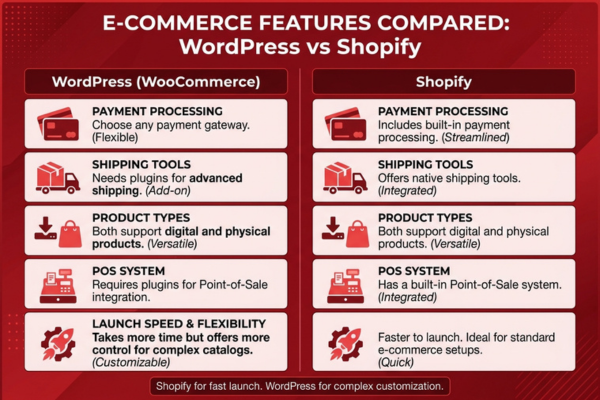
The WordPress vs Shopify debate gets intense when we talk about e-commerce features. Shopify is an e-commerce platform at its core. Every feature is built for selling. You get inventory management, abandoned cart recovery, and multi-channel selling out of the box.
WordPress relies on WooCommerce for e-commerce. WooCommerce is powerful but requires setup. You must install and configure each feature yourself. This takes more time but gives you more control.
Core e-commerce features compared:
- Shopify includes built-in payment processing
- WordPress lets you choose any payment gateway
- Shopify offers native shipping tools
- WordPress needs plugins for advanced shipping
- Both support digital and physical products
- Shopify has a built-in point-of-sale system
For pure e-commerce, Shopify is faster to launch. For complex product catalogs, WordPress with WooCommerce offers more flexibility. A great example of a well-built online store is the BundlBox e-commerce project, which shows what smart platform choices can achieve for growing brands.
SEO and Marketing Capabilities
In the WordPress vs Shopify comparison, SEO is where WordPress truly shines. WordPress is the king of search engine optimization. Plugins like Yoast SEO and Rank Math give you full control over meta tags, sitemaps, and content structure. Search engines tend to favor WordPress sites for organic rankings.
Shopify has decent built-in SEO tools. You can edit title tags, meta descriptions, and URLs. But it has limits. You cannot fully customize URL structures, and blog features are basic.
SEO advantages of WordPress:
- Full control over URL structure
- Advanced SEO plugins available
- Better blogging and content tools
- Faster content publishing workflow
- Schema markup is easy to implement
For businesses that rely on organic traffic, WordPress has a clear edge. Shopify works fine for paid ads and social selling. But for long-term SEO growth, WordPress is the better investment.
Pricing and Cost Breakdown
Cost is a major factor in the WordPress vs Shopify discussion. WordPress itself is free. But you pay for hosting, themes, plugins, and security. Shopify charges a monthly fee that includes hosting and support.
| Feature | WordPress | Shopify |
| Platform Cost | Free | $39/month and up |
| Hosting | 5–50/month | Included |
| Themes | Free to $200 | Free to $400 |
| Plugins/Apps | Free to $200/year | Free to $500/year |
| Transaction Fees | Depends on gateway | 0.5%–2% unless using Shopify Payments |
| SSL Certificate | Often free via host | Included |
WordPress can be cheaper for small sites. Shopify offers predictable pricing for stores. Your total cost depends on the features you need. It is always wise to get a free project estimate before committing to either platform so you can plan your budget accurately.
Security and Reliability
When it comes to WordPress vs Shopify for security, Shopify handles everything for you. It includes SSL certificates, PCI compliance, and automatic updates. You do not need to worry about hacking or data breaches. This peace of mind is a big plus for store owners.
WordPress puts security in your hands. You must install security plugins, update software, and choose a reliable host. If you skip updates, your site becomes vulnerable. But with proper care, WordPress can be just as secure as any platform.
Security checklist for WordPress:
- Use a trusted hosting provider
- Install a security plugin like Wordfence
- Enable two-factor authentication
- Keep all themes and plugins updated
- Run regular backups weekly
For hands-off security, Shopify wins. For full control over security measures, WordPress is the way to go.
Scalability for Growing Businesses
The WordPress vs Shopify question also matters for long-term growth. Both platforms can scale with your business. Shopify scales smoothly because it is a managed platform. You just upgrade your plan as your sales increase. There are no server issues to handle.
WordPress scales well too, but it requires more work. You may need to upgrade hosting, optimize databases, and manage caching. Large brands like Sony and Time Magazine use WordPress. This proves it can handle massive traffic volumes.
Growth factors to consider:
- Shopify handles traffic spikes automatically
- WordPress needs server upgrades for high traffic
- Shopify limits drop as you upgrade plans
- WordPress has no feature limits at any scale
- Both platforms support global expansion
For fast-growing stores, Shopify offers simplicity. For businesses expanding beyond e-commerce into content, memberships, or services, WordPress provides the room to grow in any direction.
Business Value: Which Platform Delivers More ROI?
The real question is which platform gives you the best return on investment. The answer depends on your business model and goals.
Benefits of choosing the right platform include:
- Reduced operational costs
- Faster workflows
- Improved customer experience
- Higher conversion rates
- Better long-term scalability
Benefits of AI automation include:
- Reduced operational costs
- Faster workflows
- Improved accuracy in data handling
- Smarter customer engagement
If your main goal is selling products, Shopify delivers quick ROI. If your business needs a content-rich site with a store, WordPress offers more value over time. Many modern businesses also integrate AI-powered business tools to boost efficiency and automate tasks on either platform.
The key is to match the platform to your specific needs. Do not choose based on trends alone. Choose based on your goals, team skills, and growth plans.
Start Your E-Commerce Development Project
If your company is exploring new e-commerce solutions or planning to migrate platforms, our team at Canadian Software Agency can help you design and build scalable online stores. Whether you need a high-performance Shopify store or a fully customized WordPress site, we deliver results that drive real business growth. Reach out to us today and take the first step toward a stronger online presence.
Conclusion
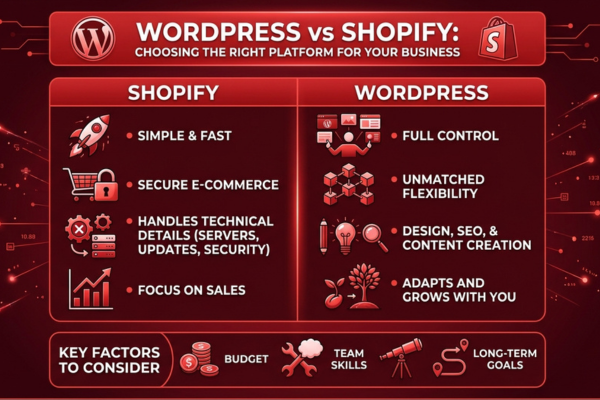
Choosing the right platform is one of the biggest decisions you will make for your online business. The WordPress vs Shopify debate does not have a single right answer. Both platforms are powerful, reliable, and trusted by millions of users worldwide. The best choice depends entirely on what your business needs right now and where you plan to go in the future.
Shopify is the best choice if you want a simple, fast, and secure way to sell products online. It handles all the technical details for you. You can focus on marketing and growing your sales. It is ideal for merchants who want to launch quickly and scale without dealing with servers, updates, or security patches. If your business is purely about e-commerce, Shopify removes the friction and lets you sell from day one.
WordPress is the best choice if you need full control over your website. It offers unmatched flexibility for design, SEO, and content creation. It is perfect for businesses that want a blog, a store, and a brand site all in one place. With the right team and tools, WordPress can do almost anything. It grows with you and adapts to every new challenge your business faces.
The WordPress vs Shopify decision comes down to your unique business needs. Think about your budget, your team’s skills, and your long-term goals. Do not rush the decision. Take time to evaluate both platforms carefully. Test demos, read reviews, and talk to experts before you commit.
If you need expert guidance, our team at Canadian Software Agency is here to help. We build custom solutions on both platforms. Whether you need a sleek Shopify store or a powerful WordPress site, we have the experience to deliver real results. Reach out to us today and let us help you build the online presence your business deserves.
Frequently Asked Questions
Q1: Is WordPress better than Shopify for small businesses?
It depends on your needs. Shopify is easier for small stores that want a quick launch. WordPress is better if you need a full website with a blog and a store. Both can work well for small businesses with the right setup.
Q2: Can I switch from Shopify to WordPress later?
Yes, you can migrate from Shopify to WordPress. The process involves moving your products, content, and customer data. It takes time and planning, but it is fully possible. Many businesses make this switch as they grow and need more control.
Q3: Which platform is better for SEO?
WordPress is better for SEO overall. It offers more control over technical SEO, content structure, and URL customization. Shopify has basic SEO tools but lacks the depth that WordPress provides through plugins like Yoast and Rank Math.
Q4: Do I need coding skills for either platform?
Shopify requires no coding for basic setup. WordPress can be used without coding too, thanks to page builders like Elementor. However, advanced customization on either platform may require some technical knowledge or a professional developer.