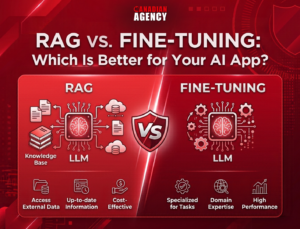

Every business wants smarter AI tools today. But picking the right path can be hard. The RAG vs Fine-Tuning debate is at the heart of modern AI development. Both methods help AI give better answers. But they work in very different ways. One pulls fresh data from your files in real time. The other retrains the model to think differently. Pick the wrong one, and you waste money and time. Pick the right one, and your team works faster and smarter. This guide breaks it all down in simple terms. You will learn what each method does and when to use it. You will also see how each one affects your budget and growth. Let us get started and find the best fit for your business.
What Is RAG?
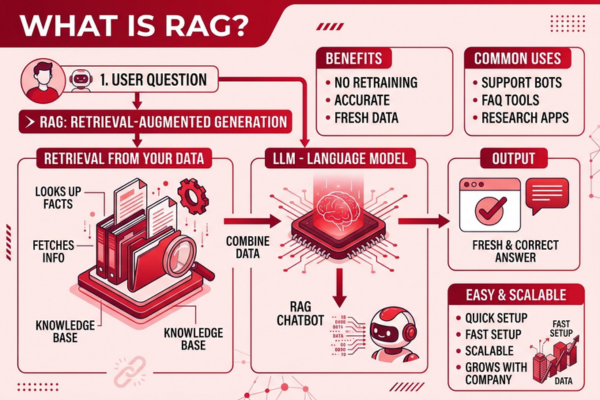
RAG stands for Retrieval-Augmented Generation. Think of it like giving your AI a search engine. The model looks up facts from your files before it answers any question. It does not memorize your data for good. Instead, it fetches info in real time from your knowledge base.
Definition: RAG is an AI method that links a language model to your data files. It gives accurate, up-to-date answers without any retraining.
This keeps answers fresh and correct at all times. You can update your files anytime you want. No retraining is needed at all. It works great for support bots, FAQ tools, and research apps. The setup is fast and very easy to manage. For most businesses, RAG is the quickest way to start using AI with their own data. It also scales well as your company grows and your data expands.
What Is Fine-Tuning?
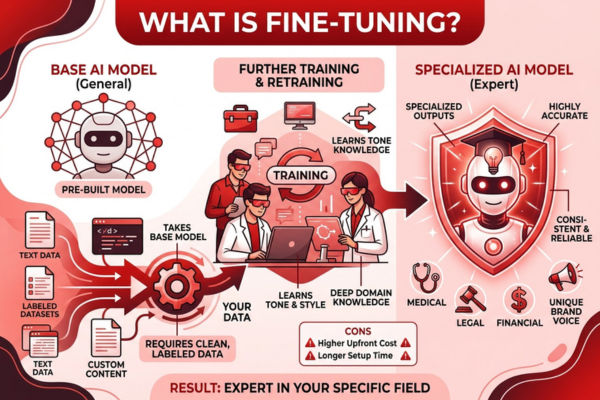
Fine-tuning takes a base AI model and trains it further on your data. The model learns your unique tone and writing style. It also learns your deep domain knowledge over time. After training, it becomes a real expert in your specific field.
Definition: Fine-tuning retrains a pre-built AI model on your custom data. This makes it produce specialized, consistent, and highly accurate outputs.
This method shines when you need a unique brand voice across all channels. It also works very well for medical, legal, or financial tasks that need precision. The downside is higher upfront cost and a longer setup time. You need clean, labeled data and skilled engineers to do it right. But once the training is complete, the results are very strong and reliable. The model responds with deep confidence in your niche area.
RAG vs Fine-Tuning: Key Differences at a Glance
Knowing the core differences helps you choose much faster. Here is a simple comparison of what matters most to your business.
| Feature | RAG | Fine-Tuning |
| Data Source | External files and databases | Built directly into the model |
| Setup Time | Days to a few weeks | Several weeks to months |
| Upfront Cost | Lower | Higher |
| Data Updates | Instant through file changes | Full retrain required |
| Accuracy Type | Great for factual lookups | Great for style and tone |
| Best Suited For | Frequently changing data | Fixed, specialized knowledge |
This table shows that neither method is always better. The right pick depends entirely on your specific business goals and data needs. Take time to review each row before you decide.
When to Choose RAG
RAG is best when your data changes often and you need quick answers. It pulls responses from live files, databases, or APIs without any delay. This makes it ideal for fast-paced industries.
Real-Time Data Needs
Does your product list update every single day? RAG keeps every answer current and correct. Just update the source file, and the AI shows the change right away. No retraining is needed at all. This alone can save your team weeks of hard work. In the RAG vs Fine-Tuning debate, RAG clearly wins for fast-moving fields like retail, news, and e-commerce. Speed and agility are its biggest strengths.
Low Cost and Easy Scaling
RAG costs much less to run over time. You pay for storage and lookups, not heavy computing power. This matters a great deal for growing businesses on tight budgets. You can start small and scale up later as your needs grow. Many teams exploring AI-powered solutions for their daily operations find RAG to be the most budget-friendly starting point for their very first AI project.
When to Choose Fine-Tuning
Fine-tuning is best when you need deep, lasting knowledge baked into the model. The AI learns your data fully and speaks your language with great fluency. In the broader RAG vs Fine-Tuning discussion, this method wins for highly specialized and complex tasks.
Niche Language Tasks
Hospitals, law firms, and banks need models that know complex terms well. Fine-tuning teaches these terms permanently and deeply. It cuts errors in high-stakes work where mistakes are very costly. OpenAI’s official guide on model customization clearly states that fine-tuning is best when basic prompts alone cannot deliver the quality you need.
Consistent Brand Voice
Does your AI need to sound exactly like your brand in every reply? Fine-tuning is the clear and best choice. It learns your tone from thousands of real examples. Every single response feels natural and perfectly on-brand. This level of consistency is very hard to achieve with RAG alone. Marketing and communications teams prefer this method for that exact reason.
Comparing Cost and Speed
Budget and timeline drive most business choices in AI. In the RAG vs Fine-Tuning conversation, cost is often the main deciding factor. RAG setups can launch in just a few days. You link your data, set up the pipeline, and start right away. Fine-tuning needs careful data cleaning, multiple training runs, and thorough testing. This full process can easily take weeks or even months.
Ongoing costs also differ a lot between the two methods. RAG charges per query and per unit of storage. Fine-tuning charges per training run and per output token. For apps with millions of daily requests, fine-tuning may actually cost less over time. For small or new apps, RAG wins on cost every single time. Always model your expected usage before you commit to either path. This step alone can save you thousands of dollars.
Accuracy and Reliability
Accuracy depends heavily on your use case and your data quality. RAG is excellent for factual questions because it cites real sources. It also cuts down on false or made-up answers by a large margin. If your AI must quote exact prices, policies, or figures, RAG is the safer choice.
Fine-tuning is excellent for smooth and natural text output. It produces fluent, confident writing in your specific domain. But it can still make errors if trained on poor or outdated data. Google AI research on language models shows that combining both methods together often gives the best overall results. For critical tasks, many smart teams use RAG for facts and fine-tuning for style. This hybrid approach gives you the best of both worlds.
Data Privacy and Security
Privacy is a top concern for businesses that handle sensitive data. With RAG, your data stays safely in your own storage systems. The AI only reads it during active queries and does not keep it. This makes regulatory compliance much easier to manage and audit.
Fine-tuning sends your data to the model provider for training purposes. You must fully trust their security and data handling policies. Some fields, like healthcare and finance, have very strict rules about data sharing. In the RAG vs Fine-Tuning evaluation, companies with tight compliance rules often lean toward RAG. Always review your industry regulations and internal security policies before you make your final choice.
Business Value of AI Automation
Adding AI to your workflows creates real, measurable value. The method you choose directly shapes your return on investment. Benefits of AI automation include:
- Reduced operational costs across all departments
- Faster workflows and much shorter response times
- Improved accuracy in all customer-facing interactions
- Better decision-making powered by real-time data insights
- Scalable solutions that grow smoothly with your business
For example, we recently built a smart tagging platform that uses AI to sort and classify data efficiently. It cut manual processing work by over 60 percent. Choosing the right AI architecture made that dramatic improvement possible from the very first day of launch.
Real-World Use Cases
Let us look at practical examples to make this much clearer. A retail store might use RAG to answer product questions from a live inventory catalog. A law firm might fine-tune a model to draft contracts in its own unique legal style.
Healthcare apps often use both methods together very effectively. RAG pulls the latest patient care guides from updated medical databases. Fine-tuning ensures the AI tone is warm, empathetic, and professional at all times. Another AI-driven platform we delivered for a client used retrieval methods to show personalized content to users in real time. This boosted user engagement and retention by a large margin. The key lesson is simple. Match the method to the task at hand. Do not force one approach where the other clearly fits better.
How to Decide for Your Business
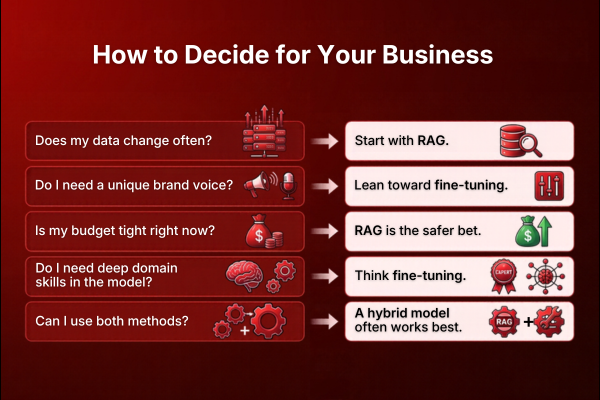
Ask yourself these simple questions to find your best answer:
- Does my data change often? Start with RAG.
- Do I need a unique brand voice? Lean toward fine-tuning.
- Is my budget tight right now? RAG is the safer bet.
- Do I need deep domain skills in the model? Think fine-tuning.
- Can I use both methods? A hybrid model often works best.
There is no single winner in the RAG vs. fine-tuning debate because every business is different. The best choice fits your data, your budget, and your long-term goals. If you need expert help figuring this out, our team can estimate your project requirements and suggest the ideal AI path tailored specifically to your business needs.
Conclusion
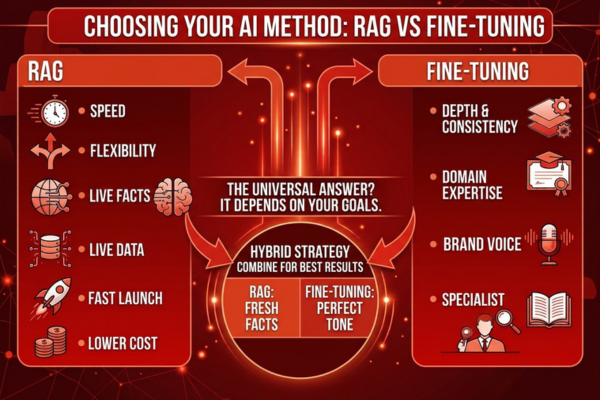
Picking the right AI method is one of the biggest tech choices your business will make this year. As we have shown throughout this guide, the RAG vs Fine-Tuning question does not have one universal answer for every company. Both methods offer strong and distinct advantages. The best choice depends entirely on your unique data, your daily needs, and your long-term business goals.
RAG gives you speed, flexibility, and real-time factual accuracy. It links your AI directly to live data sources without any costly retraining cycles. This makes it the perfect fit for businesses with changing information, tight budgets, or fast launch timelines. Fine-tuning, on the other hand, gives you unmatched depth, consistency, and specialized domain expertise. It turns a basic language model into a true expert that speaks your brand voice fluently in every single interaction.
For many smart and forward-thinking companies, the best strategy is a hybrid one. Use RAG to keep your facts fresh, current, and reliable at all times. Use fine-tuning to perfect your tone, style, and domain fluency. This powerful combination delivers AI experiences that customers genuinely trust and enjoy using. The key is to start with a clear understanding of your data, your users, and your vision for the future. AI is no longer a luxury for big tech firms alone. It is a must-have tool for businesses of every size. The sooner you pick the right approach, the sooner you will see real, measurable results that drive growth and success for your company.
Start Your AI Development Project
If your company is exploring AI solutions, our team at Canadian Software Agency can help you design and build scalable AI platforms. From initial strategy to full deployment, we handle every step with care and precision. Talk to our AI services experts today and take the first step toward smarter, faster, and more efficient business operations.
FAQs
Q1: Can I use RAG and fine-tuning together?
Yes, you absolutely can. Many successful businesses use both methods at once. RAG handles real-time factual lookups from your data. Fine-tuning handles tone, style, and domain fluency. This hybrid mix is very common in large enterprise AI setups. The RAG vs. fine-tuning choice is not always one or the other. Using both together can give you a powerful competitive edge.
Q2: Which method is cheaper for startups?
RAG is almost always cheaper to start with. You skip heavy training costs and costly data preparation. You can launch your AI product fast and learn from real user feedback. As your needs grow and your budget expands, you can add fine-tuning later.
Q3: How long does fine-tuning usually take?
Fine-tuning usually takes two to eight weeks from start to finish. This timeline includes data collection, cleaning, training runs, and quality testing. RAG setups, by comparison, can go live in just a few days. Your project timeline should strongly guide your final choice.
Q4: Is RAG better for customer support apps?
In most cases, yes. Support teams need correct, up-to-date answers from their knowledge base. RAG pulls from live documents and gives precise replies with very few errors. It is the top pick for teams that update their policies and FAQs on a regular basis.