

Online shopping has changed a lot in the past few years. Customers now expect fast results, smart suggestions, and smooth experiences at every touchpoint. This is where AI in Ecommerce steps in to make a real difference for businesses of all sizes. From suggesting the right product to answering customer questions at midnight, artificial intelligence is helping online stores work smarter and sell more.
For business owners, the value is clear. AI tools cut costs, save time, and boost revenue. They help you understand what your customers want before they even ask. Whether you run a small Shopify store or a large marketplace, AI can give you a serious edge over competitors.
In this blog, we will walk you through 10 powerful ways AI is reshaping the online shopping world. You will see real examples, clear benefits, and practical ideas you can use right away. Let us dive in and explore how smart technology is changing the way people buy and sell online.
What Is AI in Ecommerce?
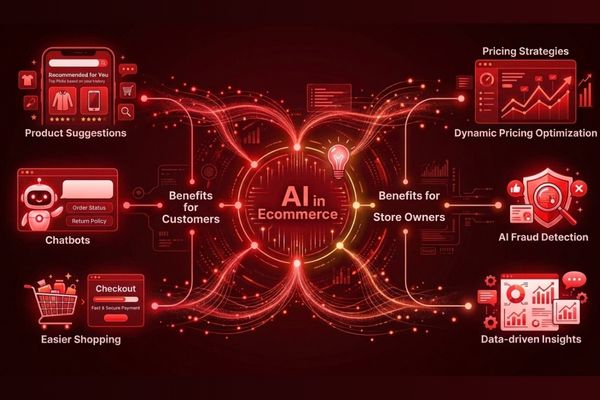
AI in Ecommerce refers to the use of artificial intelligence tools and systems to improve how online stores operate. This includes everything from product suggestions and chatbots to pricing strategies and fraud detection.
At its core, AI helps online businesses make better decisions using data. It learns from customer behaviour and adapts over time. Leading platforms from OpenAI and Google AI are driving this transformation across the global retail industry.
The goal is simple. AI makes shopping easier for customers and running a store easier for owners.
Why Online Stores Need AI Now
The online retail space is more crowded than ever. Thousands of new stores launch every month. Standing out takes more than good products and nice photos.
Adopting AI in Ecommerce is no longer a luxury. It is a necessity for brands that want to grow. Customers expect speed, a personal touch, and relevance. AI delivers all three consistently.
Here are a few reasons why AI matters right now:
- Shoppers abandon carts when experiences feel generic
- Customer support costs keep rising year after year
- Competitors are already using smart tools to win buyers
- Data volumes are too large for manual analysis
Brands that ignore AI risk falling behind fast. The good news is that getting started is easier than most people think. You can explore tailored solutions through AI development services built for growing businesses that match your budget and goals.
10 Powerful Ways AI Transforms Online Stores
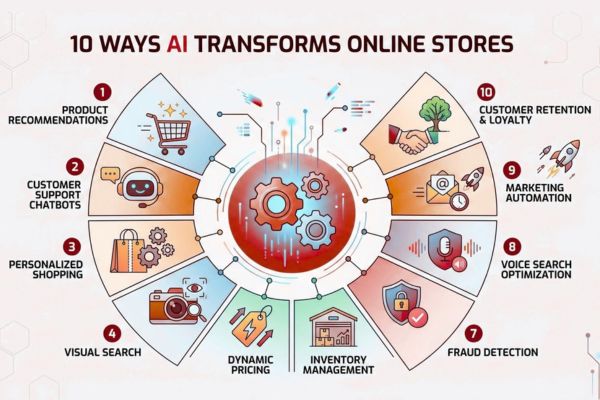
Now let us look at the 10 biggest ways AI is changing the game for online retailers today.
1. Smarter Product Recommendations
AI product recommendations are one of the most visible uses of smart technology in online stores. Think about how Amazon suggests items you might like. That is machine learning in retail at work.
These systems study what customers browse, buy, and skip. Then they show relevant items at the right moment. The result is higher average order values and better conversion rates across your store.
2. AI Chatbots for Customer Support
An AI chatbot for ecommerce can handle thousands of conversations at once. It answers questions about orders, shipping, and returns without any human help.
This means your customers get instant replies at any hour of the day. It also frees your team to focus on complex issues. AI customer service tools have been shown to reduce support costs by up to 30 percent.
3. Personalized Shopping Experiences
A personalized shopping experience goes beyond using a customer’s first name in an email. AI analyses browsing history, purchase patterns, and even time of day to tailor the entire storefront.
Two visitors can see completely different homepages based on their preferences. This level of personalization builds loyalty and drives repeat purchases over time.
4. Visual Search Technology
Visual search technology lets shoppers upload a photo and find similar products in your store. Instead of typing keywords, they simply snap a picture and get instant results.
This is huge for fashion and home decor brands. Customers see something they like on social media and want to buy it fast. Visual search removes friction and shortens the buying journey significantly.
5. Dynamic Pricing Strategies
Dynamic pricing AI adjusts your prices in real time based on demand, competition, and inventory levels. Airlines and hotels have used this for years. Now online retailers are catching on fast.
Smart pricing helps you stay competitive without losing profit margins. It reacts to market changes faster than any human team could manage manually.
6. AI Inventory Management
AI inventory management predicts what you will sell and when. It analyses seasonal trends, past sales data, and even weather patterns to keep your stock levels optimal.
This helps you avoid stockouts and overstock situations. Both problems cost serious money. With AI, your warehouse runs leaner and your cash flow improves steadily.
7. Fraud Detection and Prevention
Online fraud costs retailers billions every year. AI systems spot suspicious patterns in seconds. They flag risky transactions before they go through and protect your revenue.
This also protects your customers’ trust in your brand. Machine learning models get better over time as they process more data and learn new fraud tactics.
8. Voice Search Optimization
More shoppers use voice assistants like Alexa and Siri to find products online. AI-powered search tools help your store appear in voice search results naturally.
Optimizing for voice means using natural language in your product descriptions. It also means structuring your data so search engines can read and rank it easily.
9. Marketing Automation
Ecommerce automation powered by AI takes the guesswork out of marketing. It sends the right email to the right person at the right time without manual effort.
AI can also create ad copy, segment audiences, and optimize campaign budgets automatically. This means better ROI with far less manual work from your marketing team.
10. Customer Retention and Loyalty
When you apply AI in Ecommerce correctly, customer retention improves dramatically. AI predicts which customers are likely to leave and triggers actions to win them back.
This could be a special discount, a personalized email, or a product alert. Keeping existing customers is far cheaper than acquiring new ones, making this one of the highest-ROI use cases.
Real Business Benefits of AI Automation
The real value of AI in Ecommerce lies in measurable business outcomes. It is not just about cool technology. It is about results that show up clearly on your bottom line.
Benefits of AI automation include:
- Reduced operational costs across support and logistics
- Faster workflows from order processing to fulfilment
- Improved accuracy in demand forecasting and pricing
- Higher customer satisfaction and lifetime value
- Better decision-making backed by real-time data insights
For example, one of our recent projects involved building a custom ecommerce platform with smart AI features that helped the client reduce cart abandonment by 22 percent. Results like these are common when AI is implemented with a clear and focused strategy.
AI Development Costs for Ecommerce
Investing in AI in Ecommerce varies based on the scope and complexity of your project. A simple chatbot costs far less than a full machine learning pipeline for enterprise use.
Here is a quick breakdown to help you plan your budget:
| AI Development Type | Estimated Cost |
| AI Chatbot | $10k – $50k |
| AI SaaS Integration | $50k – $200k |
| Enterprise AI Platform | $100k+ |
The key is to start small and scale over time. You do not need to build everything at once. Pick one or two high-impact use cases and expand from there. If you want a clearer picture of costs for your specific needs, you can get a detailed project estimate from our experienced team.
Here is another look at how specific AI features translate into real business value:
| Feature | Benefit |
| AI Product Recommendations | Higher average order value |
| AI Chatbot | 24/7 support at lower cost |
| Dynamic Pricing | Competitive edge in real time |
| Visual Search | Faster product discovery |
| Fraud Detection | Reduced chargebacks and losses |
How to Get Started With AI for Your Store
Your AI in Ecommerce journey starts with a clear plan. Do not rush to adopt every tool at once. Focus on the areas where AI will have the biggest impact on your specific business.
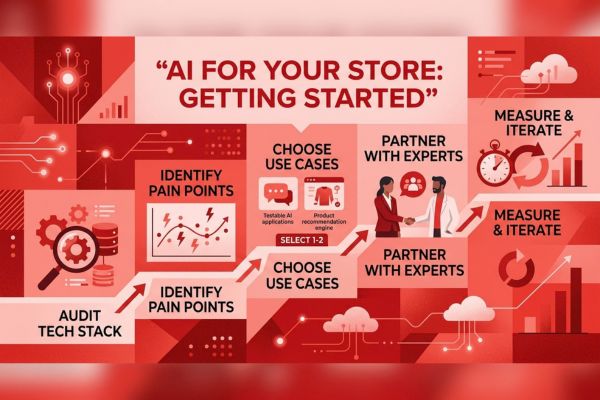
Here are the first steps we recommend:
- Audit your current tech stack and data quality
- Identify your biggest pain points in the customer journey
- Choose one or two AI use cases to test first
- Partner with an experienced development team
- Measure results and iterate quickly based on data
We recently helped a fashion brand integrate AI features into their mobile shopping app that boosted user engagement by 35 percent in just three months. The right development partner makes all the difference in your results.
Start Your AI Development Project
If your company is exploring AI solutions, our team at Canadian Software Agency can help you design and build scalable AI platforms. Whether you need a smart chatbot, a recommendation engine, or a full AI-powered storefront, we have the expertise to bring your vision to life.
Our process is simple and transparent. We start by understanding your business goals, then design a solution that fits your budget and timeline. From initial concept to final launch, we handle every step so you can focus on growing your business.
Reach out to our team today and discover how AI can give your online store a lasting competitive advantage.
Conclusion
The online retail world is evolving fast, and AI in Ecommerce is at the heart of that change. From smarter product suggestions to round-the-clock chatbots, AI gives online stores the tools they need to compete and grow in a crowded market. The 10 use cases we covered in this blog are not futuristic ideas. They are real strategies that real businesses are using right now to boost sales, cut costs, and delight customers every single day.
If you are still on the fence, consider this simple fact. Your competitors are likely already exploring AI solutions. The longer you wait, the harder it becomes to catch up. Customers today expect speed, relevance, and personalization. If your store cannot deliver that, they will find one that can. The good news is that you do not need a massive budget or a huge tech team to get started. Even small steps like adding an AI chatbot or improving your product recommendations can make a big difference in your revenue and customer satisfaction scores.
The key to success is to start with a clear goal, pick the right use case, and work with a team that understands both AI technology and ecommerce operations. When done right, AI does not just automate repetitive tasks. It transforms the entire shopping experience for your customers and the entire workflow for your business. From inventory management to fraud prevention, every area of your store can benefit from intelligent automation. The future of online retail is smart, personal, and incredibly fast. Make sure your store is ready to lead that change, not just follow it. Take the first step today and see how AI can unlock new growth for your online business.
Frequently Asked Questions
Q1: What is the best AI tool for small ecommerce stores?
For small stores, an AI chatbot and a product recommendation engine are the best starting points. They are affordable, easy to integrate, and deliver quick results within weeks.
Q2: How long does it take to implement AI in an online store?
A basic AI feature like a chatbot can be live in 4 to 8 weeks. More complex systems like dynamic pricing or full personalization engines may take 3 to 6 months depending on scope.
Q3: Will AI replace my customer service team?
No. AI handles routine questions and repetitive tasks. Your human team focuses on complex issues that need empathy and judgment. AI supports your team, it does not replace it.
Q4: Is AI safe for handling customer data?
Yes, when built correctly. Reputable AI systems follow data privacy laws like GDPR and CCPA. Always work with developers who prioritize security and compliance from day one.