
A slow or generic website can quietly cost your business leads, rankings, and customer trust. One of the biggest decisions companies face is whether to use a pre-made WordPress template or invest in custom WordPress development. While templates help businesses launch quickly, custom websites offer better flexibility, branding, SEO performance, and scalability over time.
In this guide, we break down Custom WordPress vs Templates in simple terms. You will learn the real business trade-offs: cost, speed, SEO, performance, security, and long-term value. We will also share practical use cases, feature comparisons, and decision checklists so you can choose the right path with confidence. If you are a mobile app development company (or any service business) that depends on leads, calls, demos, and trust, this decision has a clear revenue impact.
What Is the Difference Between Custom WordPress and Templates?
- Custom WordPress: A WordPress site designed and built specifically for your brand, goals, and workflows.
- WordPress Templates: Pre-made themes and page layouts that you install and edit using theme settings or page builders.
The “better” option depends on your timeline, growth goals, and how important performance, SEO, and flexibility are for your business.
Why this choice matters for business growth
When evaluating Custom WordPress websites vs templates, think beyond design. The choice affects:
- How fast your pages load (and how many visitors convert)
- How well your site ranks for search terms
- How easily you can add new pages, products, or features
- How secure and stable the site remains over time
A website is often cheaper to fix now than to rebuild later. So the best decision is the one that fits your next 12–24 months, not just this month.
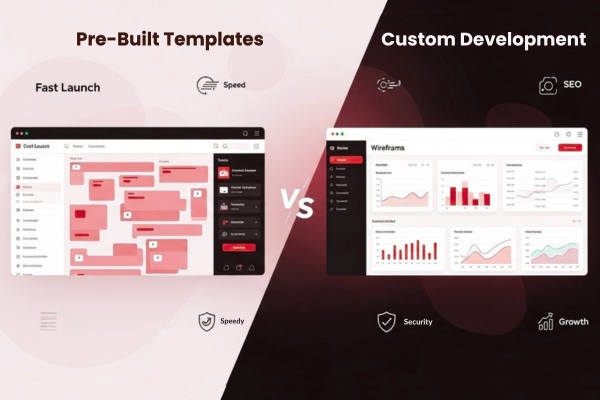
Custom WordPress vs Templates: Quick Comparison
| Feature | WordPress Templates | Custom WordPress |
| Upfront Cost | Lower | Higher |
| Launch Speed | Faster | Slower |
| SEO Flexibility | Moderate | Excellent |
| Performance | Often bloated | Optimized |
| Branding | Generic | Unique |
| Scalability | Limited | High |
| Maintenance | Plugin-heavy | Controlled |
| Conversion Optimization | Limited | Tailored |
Here’s a simple view of what most businesses experience:
- Templates are great when you need speed and a low starting cost.
- Custom WordPress is best when you need strong branding, high conversions, better SEO control, and scalability.
If your business depends on qualified leads, calls, demos, or bookings, custom usually pays back faster because it improves trust, speed, and conversion rates.
Key differences: Custom build vs template site
What changes most in real projects?
- Website performance: custom can be leaner; templates can be heavy
- SEO control: custom gives a cleaner structure; templates can be limiting
- Brand uniqueness: custom is fully original; templates look familiar
- Future changes: custom can be modular; templates can “fight back.”
When businesses compare custom WordPress development with templates, these are the areas that affect revenue, not just looks.
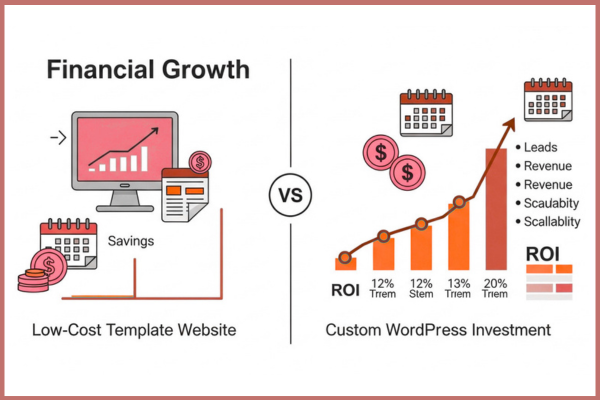
Cost and Timeline Comparison
Template websites: lower cost, faster launch
Template builds often win when you need a website live in weeks, not months.
Typical template cost drivers
- Premium theme cost
- Page builder licenses
- Paid plugins for key functions
- Extra fixes to match your brand
Custom WordPress: higher upfront, lower friction later
Custom costs more upfront because your team is designing and building systems that fit your business.
Typical custom cost drivers
- UX and UI design from scratch
- Custom theme development
- Custom blocks or components
- Performance and SEO hardening
Planning tip
If you want a realistic range before you commit, use a structured scoping process like this project cost estimation workflow: get a project estimate based on your goals and scope. It helps avoid vague budgets and surprise rebuilds.
SEO and Website Speed Comparison
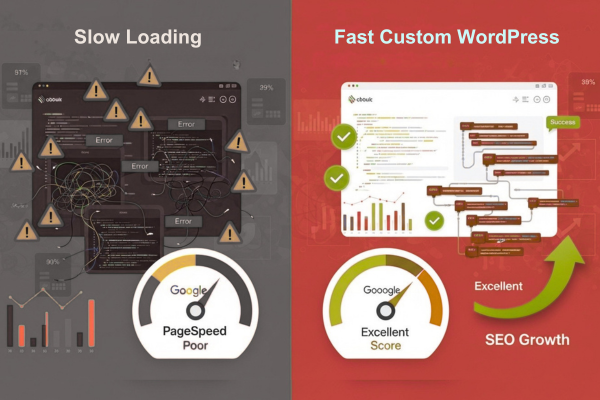
Google uses page experience and Core Web Vitals as ranking signals, meaning website speed and usability directly affect SEO visibility. Studies consistently show that slower websites experience higher bounce rates and lower conversion rates. Search engines reward fast, clear, well-structured websites. In the Custom WordPress websites vs templates debate, SEO often becomes the deciding factor.
Why templates can struggle with SEO
Templates commonly include:
- Extra scripts you do not use
- Multiple style files are loading on every page
- Page builder markup that adds “code weight”
This can slow pages down. That hurts rankings and conversions.
Why custom WordPress often wins for SEO
Custom builds can be:
- Cleaner in structure
- More focused on code
- Easier to optimize page-by-page
Authority references
For practical SEO standards and performance guidance, it helps to follow sources like Google Search Central and product thinking from OpenAI when planning content, user journeys, and helpful experiences.
Branding and User Experience
For service businesses, design is not decoration. It is trust.
Templates: “good enough” look, but familiar
A template can look polished. But prospects may feel they have “seen it before.” That can reduce perceived differentiation.
Custom WordPress: brand-first experience
Custom sites allow:
- Unique layouts that match your product or service journey
- Clear messaging hierarchy
- Consistent brand patterns across pages
In Custom WordPress websites vs templates, custom usually wins when you need:
- Higher-value deals
- Enterprise clients
- Strong differentiation in a crowded market
Scalability and Flexibility
A website that cannot adapt becomes a bottleneck.
Template limits show up when you grow
At first, templates feel flexible. But later you may need:
- New landing pages with special layouts
- More complex forms and tracking
- Better content structures for SEO
- Faster speed without breaking the theme
Custom WordPress is built to evolve
Custom sites can be designed with reusable blocks and page patterns. That makes growth simpler.
Feature vs Benefit table (business-focused)
| Feature | Benefit |
| Custom reusable blocks | Faster publishing with consistent design |
| Clean code and lean assets | Better speed and conversion rates |
| Custom post types | Stronger SEO content structure |
| Tailored navigation and UX | More leads with less confusion |
| Scalable integrations | Easier CRM, analytics, and automation |
Security and Maintenance
Security is not optional. In Custom WordPress websites vs templates, risk often comes from “too many moving parts.”
Template risk factors
Templates often depend on:
- Many plugins
- Page builders
- Theme updates that can break layouts
Each extra plugin can create:
- Compatibility issues
- Update pressure
- Security exposure
Custom WordPress can reduce the attack surface
A well-built custom theme can reduce plugin reliance. That often means fewer update conflicts and fewer vulnerabilities.
Performance and Core Web Vitals
Speed is not just technical. Speed is money.
When load time improves, you often see:
- Lower bounce rate
- Higher lead form completion
- Better SEO rankings
Templates and page builders can add weight
Many templates load assets for features you never use.
Custom can be optimized from day one
A custom build can:
- Load only what you need
- Use optimized images and scripts
- Reduce unnecessary CSS and JS
If performance matters to your funnel, Custom WordPress websites vs templates is often decided here.
When Templates Make Sense
When businesses invest in performance and UX, you usually see better engagement and conversion.
For example, modern web projects with clear UX and strong structure can support growth across channels. You can explore outcomes and design thinking in projects like the EcoTech Windows and Doors case study or a product-led experience like the Bundlbox project. These examples show how layout, messaging, and structure can support real business goals.
When Custom WordPress Is Worth It
The Custom WordPress vs Templates choice becomes simple when you map it to business outcomes.
Templates make sense when:
- You need a website to live fast
- The budget is limited right now
- You have a simple service offer
- SEO is not your main lead source yet
Custom WordPress makes sense when:
- You sell higher-value services or products
- You need strong SEO to win leads
- You run paid campaigns and need high-conversion landing pages
- You plan to scale content and add features over time
Benefits of AI automation include:
- reduced operational costs
- faster workflows
- improved accuracy
Many companies pair a strong WordPress website with automation and AI tools for lead qualification, support, and content ops. If that is part of your roadmap, you can align your site with those goals using AI services designed for business outcomes.
Cost guidance table
Even if your main focus is web, many teams now bundle web + AI features like chat, lead routing, and smart search. Here is a simple reference table you can use for early planning:
| AI Development Type | Estimated Cost |
| AI Chatbot | $10k – $50k |
| AI SaaS | $50k – $200k |
| Enterprise AI | $100k+ |
If you are considering these features, the right answer to Custom WordPress vs Templates often depends on how integrated and scalable your site needs to be.
Decision checklist: choose the right option in 10 minutes
Use this simple checklist before you decide.
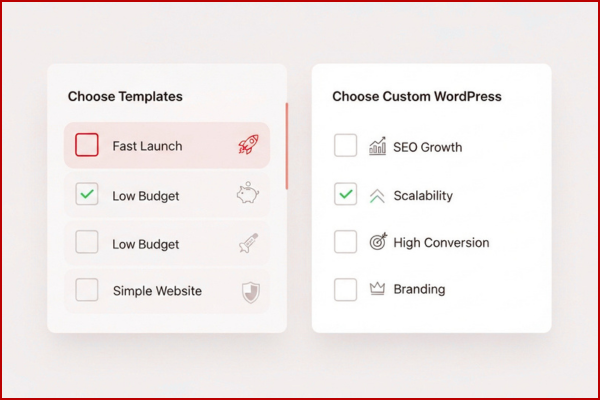
Pick templates if most of these are true:
- You need launch speed more than uniqueness
- You can accept some design limits
- You will not publish lots of SEO content
- You are okay with ongoing plugin management
Pick custom WordPress if most of these are true:
- You need a unique brand experience
- You rely on organic search or paid landing pages
- You want the fastest site possible
- You plan to scale pages, features, and integrations
In many cases, the real answer is “start lean, then evolve.” But if you already know you need performance and scale, custom is usually cheaper than rebuilding later.
Start Your AI Development Project
Your website and your product experience should work together. If you want a site that converts leads today and supports automation tomorrow, we can help you plan it properly.
Start Your AI Development Project
If your company is exploring AI solutions, our team can help you design and build scalable AI platforms. We also align your website UX, SEO structure, and automation so your funnel works end-to-end. If you want clarity on scope and pricing, you can estimate your project based on real requirements and get a clear plan.
Conclusion
The best choice between Custom WordPress vs Templates depends on what you are trying to achieve in the next phase of your business. If your priority is speed to launch and a lower starting budget, templates can be a smart move. They help you publish a clean site quickly, test your messaging, and start generating leads without long planning cycles. For early-stage services or small campaigns, that can be the right call.
But if your website is a core growth engine, the long-term value of custom is hard to ignore. In the debate between custom-built websites and WordPress themes, custom tends to win when performance, SEO, conversion rate, and flexibility matter. A custom build can give you cleaner page structure, faster load times, and a stronger brand presence. These are not “nice to have” upgrades. They directly affect how many visitors stay on your site, how many trust you, and how many take action.
Custom also reduces friction as you scale. When you want new landing pages for paid ads, new service pages for SEO, or new features like lead routing, calculators, or AI-powered support, templates can start to feel restrictive. You may end up adding plugins and workarounds that slow the site and create maintenance issues. At that stage, the cost of “cheap now” can become “expensive later.”
A practical way to decide is to measure the cost of lost opportunities. If one extra lead per week covers the difference between a template and a custom build, then custom can pay for itself quickly. If your offer is simple and you are still validating your market, a template may be the fastest path to learning.
In short, Custom WordPress websites vs templates is not only a design decision. It is a business decision. Choose templates for speed and simplicity. Choose custom when you want differentiation, better SEO outcomes, and a website that grows with your company.
FAQs
1) Is custom WordPress always better than templates?
No. In Custom WordPress websites vs templates, templates are better when speed and budget matter most, and your website needs are simple.
2) Are templates bad for SEO?
Not always. But templates often load extra code that can slow pages down. Custom builds usually allow a cleaner SEO structure and better speed.
3) Can I start with a template and switch to custom later?
Yes. Many businesses do. But plan for it. Content structure, URLs, and tracking should be set up correctly from day one to avoid SEO loss later.
4) Which option is safer?
Both can be safe if maintained well. But in Custom WordPress websites vs templates, templates often rely on more plugins and updates, which can increase risk.
5) Which is better for conversions?
Custom often wins because it can be designed around your exact user journey, not a general layout meant for many industries.