Building IRIS Robotics: A Connected Robot Management Dashboard
Industry
Robotics & Automation
Platform
Web
Launch
Early 2022
About the IRIS Robotics
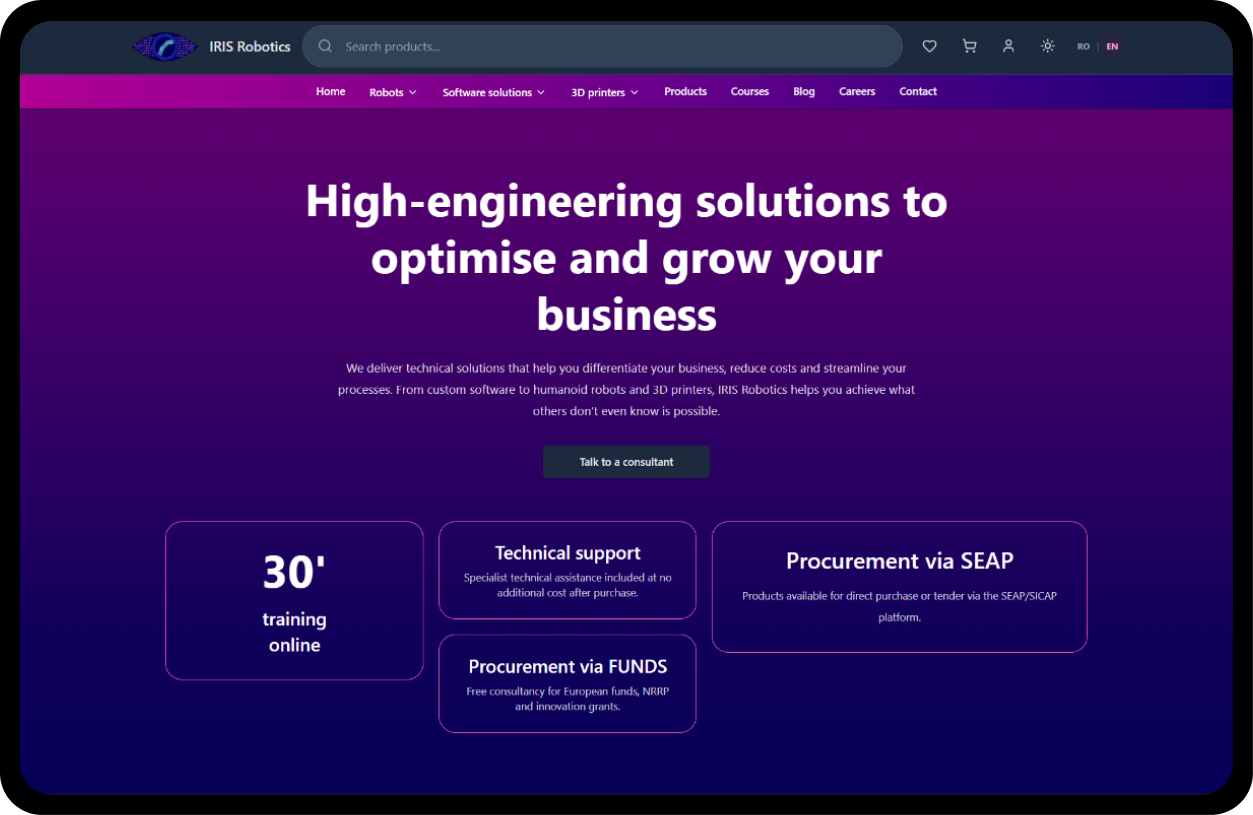
As IRIS Robotics expanded its work with physical robots and custom robotic solutions, the company needed a centralized digital platform to configure, manage, maintain, and communicate with deployed robots.
Canadian Software Agency developed a full-stack MERN-based Robot Management Dashboard that connected web-based robot entities with physical robot firmware through unique connection keys.
The platform provided administrators and users with a single interface for registering robots, monitoring and controlling their status, managing knowledge bases, remotely updating firmware, and sending commands to connected robots.
Timeline
Approximately 6 weeks
Total Development Effort
six-week intensive development
Team Size
8+ specialists
Key Deliverables
Backend/API Layer
Web-Based Robot Management Dashboard
Robot Management & Configuration System
The Challenge
Managing physical robots requires a different approach from managing conventional web applications.
Each digital robot entity within the platform needed to correspond with an actual physical robot running its own firmware. The system needed a reliable mechanism for each physical device to identify itself, establish a connection, and receive information or instructions from the management portal.
IRIS Robotics needed a centralized solution capable of supporting:
- Registration and management of multiple robots
- Unique device keys connecting robot firmware with the correct portal entity
- Remote robot activation and deactivation
- Firmware management and updates
- Remote commands and instructions
- Knowledgebase administration
- Real-time communication between robots and the dashboard
- Centralized configuration through a web interface
The core challenge was creating a reliable bridge between a traditional web-based management system and hardware operating in the physical world. Changes made through the dashboard needed to reach the correct robot while maintaining a clear relationship between each device and its corresponding platform entity.
The entire system also had to be designed, developed, tested, and prepared for production within a six-week delivery window.
The Solution
Canadian Software Agency built a complete robot management platform using the MERN stack, with Socket.IO supporting real-time communication and Firebase included within the supporting technology stack.
The resulting dashboard became a centralized operational layer between IRIS Robotics users and their physical robot fleet.
The solution included:
- React-based web management dashboard
- Node.js and Express.js backend
- MongoDB for persistent platform and robot data
- Socket.IO for real-time communication
- Firebase as part of the application infrastructure
- Unique device-key architecture connecting portal robot entities with physical robot firmware
Each robot could be registered within the dashboard and assigned a specific connection key. This key established the relationship between the robot represented in the web portal and its corresponding physical device.
Once connected, authorized users could perform remote management operations through the dashboard instead of handling every configuration change directly on individual robots.
Key Features
The IRIS Robotics dashboard included a comprehensive set of features designed to simplify robot onboarding, configuration, maintenance, content management, and remote operations.
Robot Registration & Management
Users could add new robots directly from the dashboard and manage their information through a centralized interface.
Each robot was represented as an individual entity, allowing the platform to manage devices separately rather than treating the entire fleet as one configuration.
Real-Time Robot Communication
Socket.IO was integrated to support event-driven communication between connected systems.
This allowed the platform to handle robot-related actions without relying exclusively on traditional request-and-refresh workflows, creating the foundation for interactive remote robot management.
Robot Activation & Deactivation
The platform enabled users to issue specific commands and instructions to connected robots directly from the web dashboard.
This transformed the portal from a simple robot inventory system into an operational management interface capable of interacting with connected devices.
Location-Based Service Architecture
Firmware management was integrated directly into the platform.
Authorized users could manage and initiate firmware updates through the dashboard, simplifying maintenance and reducing the need to handle individual robots separately.
Knowledgebase Management
A dedicated knowledge base management module was developed within the portal.
Users could manage knowledge and information associated with the robotic ecosystem through a centralized interface, making ongoing content administration easier for the IRIS Robotics team.
Centralized Robot Administration
The platform consolidated multiple robot-management operations into one interface.
Users could manage:
- Robot records
- Connection keys
- Operational status
- Firmware
- Knowledgebases
- Commands
- Robot-specific configurations
from a single centralized dashboard.
Tech Stack
The technology architecture was designed to support rapid product development, real-time communication, and reliable interaction between the web dashboard and robot firmware.
Core Technologies
Supporting Infrastructure & Services
See IRIS Robotics in Action
IRIS Robotics provides robotics, automation, custom software, humanoid robots, and 3D technology solutions in Romania.
Project Timeline
The complete robot management platform was developed in approximately six weeks, with the team working across the web platform, robot connectivity layer, management functionality, integration, testing, and production preparation.
- Week 1
Project Kickoff & System Architecture
Canadian Software Agency defined the architecture for the dashboard and established the relationship between users, robot entities, connection keys, the backend, and physical robot firmware.
During this phase, the team established the initial MongoDB data models, backend structure, React application architecture, and robot communication approach.
- Weeks 2–3
Core Robot Management Development
The main dashboard functionality was developed, including:
- Robot registration
- Robot information management
- Unique connection keys
- Activation and deactivation controls
- Core robot management interface
Backend functionality was developed alongside the frontend to allow the dashboard to manage robot data and operations.
- Weeks 4–5
Real-Time Integration & Advanced Features
The platform was extended with the functionality required to communicate with connected robots.
Development during this phase focused on:
- Socket. IO-based communication
- Robot commands and instructions
- Firmware management
- Firmware update workflows
- Knowledgebase management
The physical-device integration layer was connected with the portal, allowing robot entities to be associated with their corresponding physical firmware through assigned keys.
- Week 6
QA, Integration Testing & Production Preparation
The team performed end-to-end testing across the dashboard, backend, and robot connectivity layer.
Particular attention was given to:
- Device connections
- Robot identification
- Status changes
- Commands
- Firmware operations
- Administrative workflows
Issues identified during integration testing were resolved, and the application was prepared for production.
- Early 2022
Production Launch
The IRIS Robotics Robot Management Dashboard was launched at the beginning of 2022 following approximately six weeks of development.
The completed system provided IRIS Robotics with a dedicated software layer for managing connected robots through a centralized web-based interface.
- Results
A Centralized Digital Control Layer for Physical Robots
Canadian Software Agency successfully delivered a custom robot-management ecosystem that connected a modern web application with physical robot firmware.
Instead of simply maintaining robot records, the dashboard enabled users to perform meaningful operational actions remotely, including firmware management, commands, status control, device association, and knowledge base administration.
Key Outcomes
IRIS Robotics delivered a centralized digital control layer connecting web-based robot management with physical robot firmware through real-time communication and unique device keys.
Related Case Studies
Cloud 9
Dropship Academy
OPTA Dash
CDP
Frequently Asked Questions
Can Canadian Software Agency develop custom robot management dashboards?
Can Canadian Software Agency integrate web applications with physical robots?
Yes, we develop backend APIs and device-connection systems that link web platforms with physical robots and their firmware.
Can Canadian Software Agency build real-time communication systems for robotics?
Can Canadian Software Agency implement remote firmware management and robot controls?
Can Canadian Software Agency develop scalable IoT and robotics platforms using the MERN stack?
-
- Posted by Canadian Agency Web Development Team
Webflow Website Development: How to Build a Website That Drives Real Results
-
- Posted by Canadian Agency Web Development Team