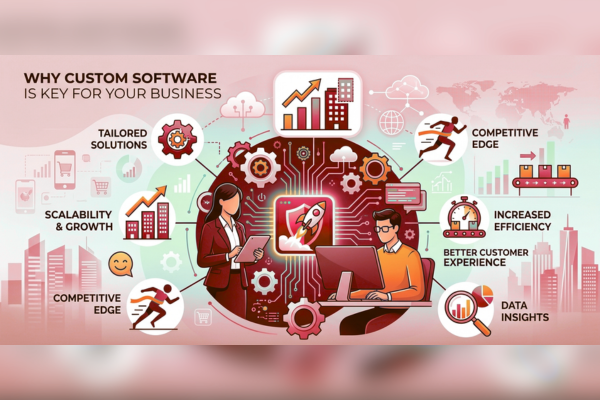
Businesses change all the time. Customer needs shift. Teams grow. New channels appear. A tool that worked last year may slow you down this year. That is why custom software development matters for modern companies. It gives you software that fits your workflow, your users, and your goals. You are not forced to change your business to match a generic product.
In simple words, it means building software made for one business. It can be a mobile app, a web portal, an internal system, or a platform with AI features. The value is practical: faster work, fewer errors, stronger security, and a better customer experience. You also gain more control over costs because you pay for what you truly need.
In this blog, you will learn why it is important, how it supports AI and automation, what it costs, and how to plan a project with less risk.
What is custom software development?
It is the process of building software specifically designed for a single business. It is tailored to unique workflows, users, and goals instead of a general market solution.
1) The real issue with off‑the‑shelf software
Off‑the‑shelf tools can be useful. They are fast to buy and easy to start. Many companies begin this way. But as you grow, these tools can become a daily problem.
Common pain points include:
- Your team must work around the tool
- Features are missing in key steps
- You pay for features you never use
- Reporting is limited or confusing
- Integrations cost extra and break often
- Updates change things you rely on
These limitations are the main reason businesses look for solutions designed to match their workflows. You also face a silent cost: time. Small delays add up across teams. A few extra steps in a process can waste hours each week.
It solves this by shaping the product around your workflow. Instead of adapting people to software, you adapt software to people. That improves speed, accuracy, and morale.
A simple test: “Are we using workarounds daily?”
Ask your teams one question:
- “Do you use a spreadsheet, email thread, or manual step to finish what the tool cannot do?”
If the answer is yes, you likely have a strong case for developing software that fits your workflows.
2) How Custom Software Creates a Competitive Advantage
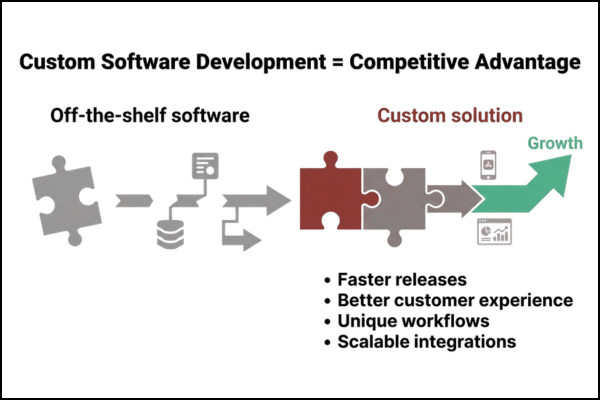
In many industries, the best product wins. But “best” is often about small details: faster onboarding, smoother mobile flows, and quicker support. Generic tools rarely deliver those details for your exact customer base.
The right software solution empowers you to:
- Build a unique customer experience
- Launch updates faster than competitors
- Add features based on real usage data
- Protect your product roadmap from copycats
- Remove friction from buying and support
This is not about adding “more features.” It is about building the right features that reduce effort and increase trust.
Where does the advantage show up first
Custom-built systems often create quick wins in:
- Mobile app sign-up and onboarding
- Order tracking and delivery updates
- Self-service support portals
- Account management and renewals
- Personalization in content and offers
These areas touch the customer directly. That is why they often show ROI early.
3) Better workflow automation and clear ROI (business value)
Manual work is expensive. It also creates mistakes, delays, and inconsistent service. Automation helps you reduce these issues. It also makes results more predictable.
Business Value Section
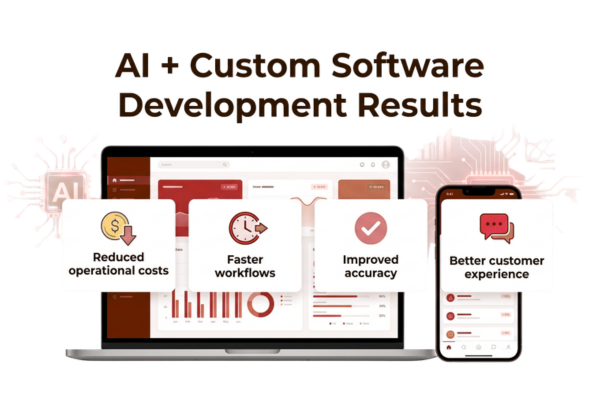
Benefits of AI automation include:
- reduced operational costs
- faster workflows
- improved accuracy
- fewer repetitive tasks
- better response times for customers
Software designed around your business processes makes automation more effective. It follows your existing workflows instead of forcing them into a one-size-fits-all automation model.
High-ROI tasks to automate
Start with repetitive tasks that follow clear rules:
- Data entry and validation
- Approvals and routing steps
- Customer ticket tagging and assignment
- Inventory updates and alerts
- Billing reminders and payment follow-ups
- Staff onboarding checklists
Once these are automated, you can move to smarter automation using AI models.
4) AI models explained
AI can sound complex. The business goal is not complexity. The goal is better decisions and less manual work. Custom software makes AI integration practical by embedding models directly into business workflows.
Here is a simple view of common AI models and how they help:
- Machine learning (ML): predicts outcomes using past data
- Example: predicts churn risk or demand
- Natural language processing (NLP): understands text and language
- Example: tag tickets, summarize emails
- Computer vision: understands images
- Example: read documents, detect defects
- Generative AI: creates content like text, summaries, and drafts
- Example: write first replies for support, create product descriptions
AI is most valuable when it is built into a workflow. That is where it helps. You can place AI at the exact step where time is lost, or decisions are slow.
For reliable background and updates, it is worth following leaders like OpenAI and Google AI.
What AI does well in business apps
AI is strong when it supports one of these outcomes:
- Make a choice faster (recommendations)
- Reduce human effort (summaries and extraction)
- Improve consistency (classification and scoring)
- Help people find answers (search and chat)
AI is weaker when goals are vague. So define success in simple metrics: time saved, error rate reduced, or customer wait time improved.
5) Custom Software Development Cost and AI Pricing Models
Costs depend on your scope, data, integrations, and security needs. Use this table as a rough planning guide.
| AI Development Type | Estimated Cost |
| AI Chatbot | $10k – $50k |
| AI SaaS | $50k – $200k |
| Enterprise AI | $100k+ |
It helps you control spend because you can launch a smaller version first, prove value, and then expand.
What usually drives AI costs up
Common cost drivers include:
- Many integrations across systems
- Large volumes of user traffic
- Complex permission rules and audit needs
- Data cleanup and labeling requirements
- High-accuracy targets for critical decisions
A good build plan tackles these early, before they become surprises.
6) Integration: connect systems instead of switching tools
Most businesses use many tools: CRM, accounting, support desk, analytics, inventory, and marketing platforms. When systems do not connect, teams waste time moving data around. That creates errors and delays. It also makes reporting unreliable.
Software designed around your operations supports integration from day one. You can decide:
- What data flows between systems
- When it syncs (real-time or scheduled)
- How errors are handled
- How security is enforced
Benefits of strong integration include:
- Less double entry
- Faster service and follow-ups
- More accurate billing and records
- Better dashboards and forecasting
If your platform is growing, API stability becomes a real business need. This article on API versioning best practices for scalable software systems supports long-term scaling without breaking existing users and partners.
Common integration patterns (simple words)
Most integrations fall into a few patterns:
- Sync records: keep customer data the same across tools
- Trigger actions: create an invoice when an order is paid
- Pull reports: show KPIs in one dashboard
- Share events: notify systems when a user takes action
These patterns are easier to manage when they are planned as part of the product architecture.
7) Security, compliance, and better data control
Security is not just an IT concern. It is a business risk issue. A breach can mean lost revenue, legal costs, downtime, and brand damage.
Generic tools can limit your control over:
- Where data is stored
- How access is managed
- What logs you can view
- How do you prove compliance
- How fast can you respond to new rules
Software designed around your business gives you greater control over security. You can build protections that match your risk profile and enforce the right rules for each role.
Practical security features that matter
Here are security elements that often bring immediate value:
- Role-based access (people only see what they should)
- Strong authentication options (like MFA)
- Encryption for sensitive data
- Audit logs for key actions
- Rate limits and monitoring for APIs
- Regular testing before release
These steps help build trust with customers and partners while easing the pressure of compliance audits. A purpose-built solution improves security by giving you full control over user access, data, and regulatory requirements.
8) Custom Software Development for Better Reporting and Business Intelligence
Leadership needs clear numbers. Many off‑the‑shelf tools provide reports, but they often do not match how you run your business. You may need to export data and build manual reports. That wastes time and reduces trust in the numbers.
It lets you track what matters to you, not what is easiest for a tool to measure.
Examples of high-value dashboards:
- Sales pipeline by region, product, and stage
- Support volume by topic, channel, and time
- Mobile app retention by feature usage
- Revenue by cohort and customer type
- Delivery time by supplier and location
When your dashboard reflects real operations, decisions become faster and more confident.
A strong example of turning complex performance data into usable insights is the Opta Dash analytics project, where clarity and usability are core goals.
Small reporting improvements that add up
Even basic improvements can save hours:
- One source of truth for metrics
- Automated weekly reports
- Alerts when KPIs drop
- Simple filters for teams and managers
9) Feature vs Benefit mapping (table)
A useful way to justify a build is to map each feature to a clear business benefit. This keeps the project focused. It also improves stakeholder alignment.
| Feature | Benefit |
| Role-based access | Better control and fewer mistakes |
| Automated approvals | Faster cycle times |
| Real-time dashboard | Faster decisions |
| Mobile-first UX | Higher user adoption |
| AI text summaries | Less manual work for teams |
| System integrations | Fewer errors and less rework |
| Self-service portal | Lower support load |
| Audit logs | Easier compliance and investigations |
The greatest value comes from software designed around your business when every feature can be linked to a measurable outcome.
10) Mobile apps: why custom matters even more on mobile
Mobile users are impatient. They expect fast load times, simple flows, and clean design. Many generic platforms struggle here because they try to serve everyone. Mobile app development is often most effective when built through custom software because it improves performance and user experience.
With it, a mobile app can be built for:
- Your exact user journey
- Your unique push notification strategy
- Offline use cases (when needed)
- Device features (camera, location, biometrics)
- Performance targets and analytics
Mobile benefits that executives care about
For business leaders, mobile success often ties to:
- Higher conversion
- Stronger retention
- Better engagement
- Lower support cost
- More repeat purchases
Custom development helps you test and improve these metrics faster.
11) Scalability in Custom Software Systems
Some systems fail not because the idea is bad, but because the product cannot handle growth. Slow apps create user frustration. Unstable systems create lost revenue.
It supports scalability planning early, including:
- Performance targets (speed and load)
- Database and caching choices
- Clean API design
- Monitoring and alerting
- Release processes that reduce downtime
You do not need to “overbuild.” But you do need a plan to grow safely.
A simple scaling checklist
- Can we add new users without slowing down?
- Can we add new features without breaking old ones?
- Can we track issues before customers complain?
- Can we roll back a release quickly?
If you can answer “yes,” your platform is on a stronger path.
12) Product ownership and long-term cost control
Many teams fear custom projects because they assume it is always more expensive. The truth is more balanced. Off‑the‑shelf tools may look cheaper at first, but costs can grow:
- Per-user fees rise as staff grows
- Add-ons become required
- Integration work becomes complex
- Vendor limits slow your roadmap
- You pay forever and still do not own the product
With a tailored software solution, you invest in a long-term business asset. You can improve it over time and control your priorities.
Where custom reduces long-term cost
Custom projects can lower costs through:
- Automation that reduces headcount pressure
- Less rework and fewer errors
- Fewer paid tools are needed across teams
- Better retention due to stronger UX
- Faster launches and fewer delays
A clear plan and staged releases are key. That is how you keep spending aligned with value.
13) When custom is the right choice (and when it is not)
Not every project should be custom. A smart strategy mixes tools and custom builds.
Choose custom software when:
- Your process is unique and core to value
- You have daily pain points and workarounds
- Integrations are essential to operations
- You need strong security and compliance control
- You want AI automation in key workflows
- You must deliver a differentiated mobile experience
Consider off‑the‑shelf when:
- Your needs are common and simple
- You are testing a market with a low budget
- Your process is not a competitive edge
- You do not have time for product ownership
A practical middle approach
Many companies start with one custom module:
- A customer-facing mobile app
- A custom admin portal
- A dashboard layer that unifies data
- A small AI feature that saves time
Then they scale based on results.
A good example of building advanced capability with focus is the Neuro Ascent project, where targeted work supports growth over time.
14) How to plan a successful project
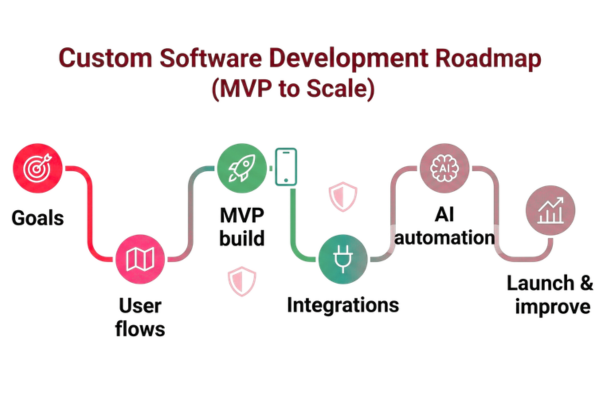
A great custom project is not about big documents. It is about clear goals, small releases, and constant learning.
A simple plan that works:
- Define the goal in one sentence
- List the top user types
- Map 5–10 key user flows
- Pick success metrics (KPIs)
- Build an MVP (first useful version)
- Release, measure, and improve
Custom software succeeds when teams treat the product as something that evolves, not something that finishes once.
Estimation prevents surprises
One of the biggest reasons projects fail is unclear scope. Good estimation helps you choose what to build now and what to build later.
If you are planning a build, it helps to estimate your software project based on your scope and timeline before you commit to a roadmap.
15) Common mistakes to avoid (and how to prevent them)
Custom projects fail for predictable reasons. The good news is you can prevent many of them with simple habits.
Common mistakes:
- Building too much before user feedback
- Unclear priorities across stakeholders
- No measurable success metrics
- Weak testing and rushed release
- Ignoring performance until it is too late
- Poor API planning during growth
How to prevent them:
- Ship small, learn fast
- Keep a single priority list
- Use basic analytics from day one
- Test core flows every sprint
- Set performance targets early
- Follow stable API rules for change management
The earlier you manage these risks, the smoother the project.
Start Your AI Development Project
If your company is exploring AI automation, a new mobile app, or a platform refresh, our team at Canadian Software Agency can help you plan and build a scalable solution with clear milestones and measurable results. You can explore our AI services for business-focused software delivery to see how we support strategy, design, development, and launch.
Start Your AI Development Project by choosing one workflow that wastes time today. We will help you turn it into a tested MVP, then scale it with confidence.
Conclusion
Custom software development is important because it gives you control and clarity. You control the customer experience, the workflows, the data, and the roadmap. You can automate repetitive work, reduce errors, integrate systems cleanly, and add AI features where they truly save time. Done well, it turns software into a business asset that grows with you, instead of a tool that holds you back.
FAQs
1) How long does custom software usually take?
A simple MVP can take 8–16 weeks. Larger products often take several months. Time depends on scope, integrations, and testing needs.
2) Is custom software only for large companies?
No. Many small and mid-sized businesses benefit when a key workflow is unique or when manual work is slowing growth.
3) Can AI be added to existing software?
Yes. AI can be added through features like summaries, smart search, recommendations, and automated routing. The best results come from clear goals and clean data.
4) How do we measure ROI from a custom build?
Track baseline numbers first, then measure improvements like time saved, fewer errors, faster cycle time, higher conversion, or better retention.
5) What is the biggest risk in a custom project?
Unclear scope. You reduce risk by defining key user flows, choosing success metrics, and releasing in small stages.