
Every business wants to stay ahead of the pack. The market moves fast. New tools appear every single day. But one trend stands out above all the rest. Companies that build an AI competitive advantage are growing faster than their rivals. They make smarter decisions. They serve customers better. They cut costs without cutting quality.
This blog explores how real businesses use AI competitive advantage to dominate their industries. We will cover practical strategies, real costs, and clear benefits. You will learn what works and what does not. Whether you run a start-up or a large firm, this guide will help you take action.
The value is simple. AI competitive advantage is not just a buzzword. It is a measurable edge. Companies using AI in business report higher revenue, lower waste, and happier customers. Let us break it all down so you can start winning today.
What Is AI Competitive Advantage?

AI competitive advantage is the unique edge a company gains by using artificial intelligence to outperform rivals in speed, cost, quality, or customer experience.
In simple terms, it means using AI tools to do things better than your competition. This could mean faster service. It could mean lower prices. It could mean products that adapt to user needs in real time.
AI competitive advantage comes from three core areas:
- Data: You collect and use data better than others.
- Speed: You make decisions faster using smart algorithms.
- Scale: You serve more customers without adding more staff.
When a company combines these three areas, the result is a strong AI competitive advantage that is hard for rivals to copy.
Why AI Competitive Advantage Matters in 2025
The business world has changed. Customers expect instant answers. They want personal experiences. They switch brands quickly if they are not happy.
An AI competitive advantage helps you meet these demands. Here is why it matters right now:
- Markets are more crowded than ever.
- Customer expectations keep rising.
- Manual processes are too slow and costly.
- Competitors are already investing in AI.
If you wait too long, you fall behind. A strong AI competitive advantage is no longer optional. It is a survival tool.
Research from Google AI shows that companies adopting AI early see up to 20% higher productivity. That gap only grows over time.
How AI in Business Drives Real Results
AI in business is not about fancy robots. It is about solving real problems. Here are the top ways companies use AI to get results:
- Smarter hiring: AI scans resumes and finds top talent fast.
- Better pricing: AI adjusts prices based on demand in real time.
- Fewer errors: AI checks data and catches mistakes humans miss.
- Faster support: AI chatbots answer customer questions 24/7.

Each of these use cases builds a lasting AI competitive advantage. The key is to start small. Pick one problem. Solve it with AI. Then expand.
Key Areas Where Companies Gain an AI Competitive Advantage
Customer Experience
Happy customers come back. AI helps you understand what they want before they even ask. Tools powered by natural language processing can read customer reviews, emails, and chat logs. They find patterns that humans cannot see.
For example, a retail brand used AI to track customer mood in real time. They adjusted their offers within minutes. Sales went up by 15%. That is a clear AI competitive advantage in action.
Operations and Supply Chain
AI predicts supply shortages before they happen. It reroutes shipments when weather changes. It cuts warehouse waste by up to 30%. These improvements give companies a serious AI competitive advantage over rivals still using spreadsheets.
Marketing and Sales
AI tools analyse buyer behaviour at scale. They send the right message to the right person at the right time. This boosts conversion rates and lowers ad spend. Companies using predictive analytics in marketing report 25% higher ROI on campaigns.
AI Automation and Its Impact on Growth

AI automation is one of the fastest ways to build an AI competitive advantage. It removes slow, repetitive tasks from your team’s plate.
Benefits of AI automation include:
- Reduced operational costs
- Faster workflows
- Improved accuracy
- Better use of employee time
- Fewer human errors
When your team spends less time on data entry, they spend more time on strategy. That shift alone can create a powerful AI competitive advantage.
Many businesses start with simple AI chatbot development to handle customer queries. This single step can cut support costs by 40% while improving response times.
Building AI-Powered Apps for Market Leadership
Mobile apps are a direct line to your customers. When you add AI to those apps, the results can be dramatic. AI-powered apps learn from user behaviour. They adapt content, features, and recommendations on the fly.
Consider how companies like HoopFind used smart technology to connect users in real time. The app grew quickly because it solved a real problem with speed and precision.
Key features of successful AI-powered apps include:
- Personalized user dashboards
- Smart search and recommendations
- Voice and image recognition
- Real-time notifications based on behaviour
Each feature adds to your AI competitive advantage by making your app stickier and more valuable to users.
The Role of Predictive Analytics in Decision-Making
Predictive analytics uses past data to forecast future trends. It helps leaders make better choices with less guesswork.
Here is how it works in practice:
- A bank uses AI to predict loan defaults before they happen.
- A retailer forecasts which products will sell out next month.
- A hospital predicts patient admission rates to staff correctly.
These examples show how predictive analytics creates an AI competitive advantage across industries. The companies that act on these insights first are the ones that win.
Tools from OpenAI are making these capabilities more accessible than ever. Even small teams can now build powerful forecasting models.
AI Development Cost: What to Expect
Many leaders worry about the price tag. The truth is that AI development cost varies widely based on scope and complexity.
Here is a simple breakdown:
| AI Development Type | Estimated Cost |
| AI Chatbot | $10k – $50k |
| AI SaaS Platform | $50k – $200k |
| Enterprise AI | $100k+ |
| AI-Powered Mobile App | $30k – $150k |
| Predictive Analytics Tool | $20k – $80k |
The key is to view AI development cost as an investment, not an expense. A well-built AI tool can pay for itself within months through savings and new revenue.
If you want a clear picture of your project costs, you can get a detailed project estimate tailored to your business needs.
Enterprise AI vs. Small Business AI
Not every company needs the same AI solution. Enterprise AI focuses on large-scale data, complex workflows, and deep integration with existing systems.
Small businesses, on the other hand, benefit from simpler tools. An AI chatbot or a basic recommendation engine can be enough to build an AI competitive advantage.
| Feature | Enterprise AI | Small Business AI |
| Data Volume | Millions of records | Thousands of records |
| Integration | ERP, CRM, HR systems | Single platform |
| Team Size | Dedicated AI team | 1–2 developers |
| Timeline | 6–18 months | 1–4 months |
| Cost | $100k+ | $10k–$50k |
Both paths lead to a strong AI competitive advantage. The difference is scale, not strategy.
How to Build Your Artificial Intelligence Strategy
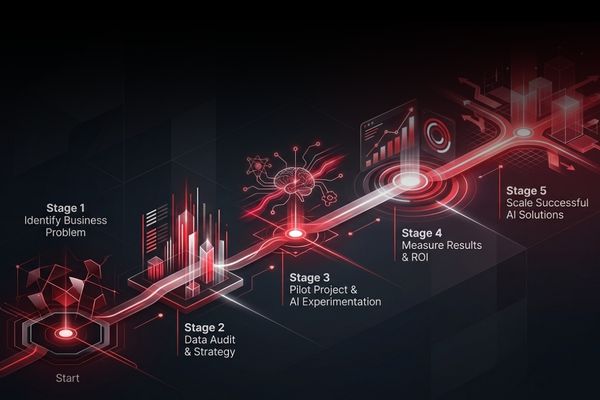
A clear artificial intelligence strategy is the foundation of lasting success. Without a plan, AI projects fail. Here is a simple roadmap:
- Identify your biggest pain point. Where do you lose time or money?
- Audit your data. AI needs clean, organized data to work.
- Start with one pilot project. Do not try to fix everything at once.
- Measure results. Track cost savings, speed gains, and customer feedback.
- Scale what works. Expand successful pilots across your business.
Working with an experienced team can speed up this process. Companies that explore professional AI services often launch their first AI solution in under three months.
A strong artificial intelligence strategy turns scattered efforts into a focused AI competitive advantage.
Real-World Examples of AI Competitive Advantage
Smarter Urban Solutions
The GreenTag project used intelligent technology to improve sustainability tracking. By automating data collection and analysis, the platform gave its users a clear edge in the green tech market.
Memory and Data Management
The Espace Mémoire platform leveraged smart data tools to organize and retrieve information faster than traditional methods. This speed became a direct AI competitive advantage for its users.
Gaming and Analytics
The PlayerDex project applied data-driven insights to enhance user engagement. Real-time analytics helped the platform grow its user base quickly.
These examples prove that AI competitive advantage is not limited to tech giants. Any company can achieve it with the right approach and the right partners.
Machine Learning Solutions That Deliver Results
Machine learning solutions are the engine behind most AI tools. They learn from data and improve over time without human input.
Common machine learning solutions include:
- Fraud detection systems
- Product recommendation engines
- Demand forecasting models
- Image and speech recognition tools
Each of these solutions strengthens your AI competitive advantage by making your business smarter every single day. The more data you feed the system, the better it performs.
Common Mistakes to Avoid
Building an AI competitive advantage is not always smooth. Many companies make the same errors:
- Skipping the data clean up. Bad data leads to bad AI.
- Trying to do too much at once. Start small and scale.
- Ignoring user feedback. AI should serve real human needs.
- Choosing the wrong partner. Expertise matters more than price.
- Failing to measure ROI. If you cannot track results, you cannot improve.
Avoid these traps, and your path to AI competitive advantage will be much clearer.
Conclusion
The business landscape is shifting fast. Companies that ignore AI risk falling behind. Those that act now are building a lasting AI competitive advantage that compounds over time. From smarter customer service to faster operations, AI touches every part of modern business.
The key takeaway is simple. AI competitive advantage is not about having the biggest budget. It is about solving real problems with smart tools. Start with one use case. Measure your results. Scale what works. Whether you invest in AI automation, predictive analytics, or AI-powered apps, the goal is the same. You want to serve your customers better than anyone else.
The cost of inaction is high. Your competitors are already exploring machine learning solutions and building their own AI competitive advantage. Every month you wait, the gap grows wider. The good news is that getting started is easier than you think. With the right strategy and the right team, you can launch your first AI project in weeks, not years.
Remember, AI competitive advantage is a journey, not a destination. The technology will keep evolving. Your strategy should evolve with it. Stay curious. Stay flexible. Keep testing new ideas. The companies that treat AI as a core part of their business — not a side project — are the ones that will lead their industries for decades to come.
Your AI competitive advantage starts with a single decision. Make it today.
Start Your AI Development Project
If your company is exploring AI solutions, our team at Canadian Software Agency can help you design and build scalable AI platforms. From AI chatbot development to full enterprise AI systems, we deliver results that matter.
Do not let your competitors get ahead. Build your AI competitive advantage today. Talk to our team and get a free project estimate tailored to your goals.
Frequently Asked Questions
- What is an AI competitive advantage?
An AI competitive advantage is the unique edge a company gains by using artificial intelligence to outperform rivals in speed, cost, quality, or customer experience. - How much does AI development cost?
AI development costs range from $10,000 for a simple chatbot to over $100,000 for full enterprise AI systems. The price depends on complexity and scope. - Can small businesses benefit from AI?
Yes. Small businesses can build an AI competitive advantage with simple tools like chatbots, recommendation engines, and basic analytics dashboards. - How long does it take to build an AI solution?
Most AI projects take 1 to 6 months for a working pilot. Larger enterprise AI systems may take 12 to 18 months. - What is the best way to start with AI?
Start by identifying your biggest business pain point. Then explore AI services that match your needs and budget.