
Introduction: AI Is Changing, and It Is Changing Fast
Businesses want results. They want speed. They want fewer errors and lower costs.
Multi-Agent Systems are making all of that possible right now.
A Multi-Agent System is a group of AI agents that work together. Each agent handles a specific job. Together, they complete tasks that one AI could never do alone.
Think of it like a well-organized team. Everyone has a role. Everyone communicates. The work gets done faster and better.
This technology is not a future concept. It is live. It is working. And it is already helping businesses save time and money across industries.
In this blog, you will learn what agent-based systems are, how they work, and why your business should pay attention to them.
What Are Multi-Agent Systems?
A Multi-Agent System is a network of AI programs. Each program, called an agent, works on its own task. The agents also communicate with each other to reach a shared goal.
This is different from a single AI tool. A regular AI does one thing. A Multi-Agent System does many things at once.
Here is what makes these systems stand out:
- Each agent is independent — It makes its own decisions
- Agents talk to each other — They share data and updates
- The system adapts — It adjusts when things change
- It scales easily — Add more agents when you need more power
This flexibility is why companies are moving toward collaborative AI systems fast.
How Do agent-based systems Actually Work?
Let us break it down into simple steps.
Step 1 — Break the task down
A big task gets split into smaller pieces.
Step 2 — Assign each piece
Each agent gets a specific job to do.
Step 3 — Agents get to work
They each complete their task at the same time.
Step 4 — Agents share updates
They communicate in real time so nothing gets missed.
Step 5 — Results come together
The final output is delivered quickly and accurately.
Who Manages the Agents?
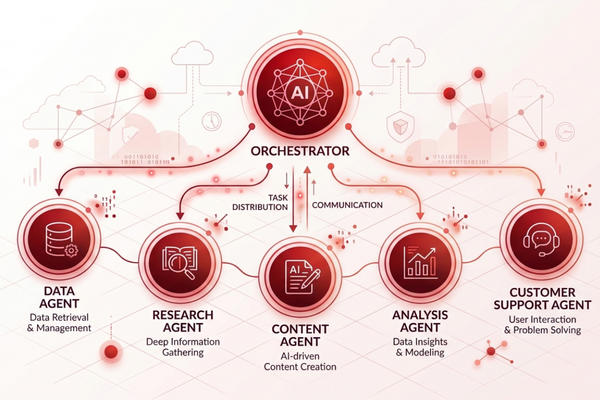
One agent acts as the manager. This is called the orchestrator. It assigns tasks and makes sure everything runs smoothly.
The other agents are the workers. They focus on their specific jobs, such as searching for data, writing content, or flagging errors.
This structure makes collaborative AI systems powerful and reliable.
Real-World Use Cases You Can Relate To
Agent-based systems are already being used in real businesses. Here are some clear examples.
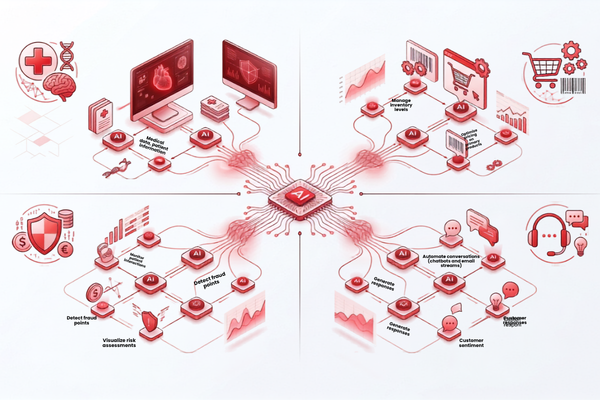
Healthcare
- One agent gathers patient history
- Another checks symptoms
- A third suggests treatment options
- All three work together in seconds
E-Commerce
- Agents track inventory levels
- They adjust prices based on demand
- They notify the team when stock is low
- All of this happens without any human input
Finance
- One agent monitors transactions
- Another flags suspicious activity
- Fraud is detected and reported instantly
Customer Support
- One agent reads the customer message
- Another finds the right answer
- A third sends the reply and logs the case
Want to see how AI can power a real product? The PlayerDex project is a great example of intelligent systems built for real users.
Why Businesses Are Investing in Multi-Agent Systems
The business case is strong. Here is why companies are making the move.
Benefits of AI Automation Include:
- Reduced operational costs — Less manual work means lower staffing costs for routine tasks
- Faster workflows — Work that took days now takes minutes
- Improved accuracy — Agents do not lose focus or make tired mistakes
- Always-on availability — Systems run 24 hours a day, 7 days a week
- Easy to scale — Grow the system without rebuilding it
- Smarter decisions — Agents process large amounts of data quickly
Businesses that adopt agent-based systems early gain a real edge. Your human team gets freed up to focus on strategy and creativity. The repetitive work gets handled automatically.
That is a powerful combination.
Multi-Agent Systems vs Traditional AI: Side-by-Side Comparison
| Feature | Traditional AI | Multi-Agent Systems |
| Task handling | One task at a time | Many tasks at once |
| Adaptability | Limited | High |
| Scalability | Hard to grow | Easy to grow |
| Decision-making | One central point | Spread across agents |
| Failure resilience | Low | High |
| Real-time teamwork | No | Yes |
The difference is clear. Collaborative AI systems are not just better AI. They are a smarter way to work.
What Does It Cost to Build an AI System?
Cost is always a key question. Here is a straightforward breakdown.
| AI Development Type | Estimated Cost |
| AI Chatbot | $10,000 – $50,000 |
| AI SaaS Platform | $50,000 – $200,000 |
| Enterprise AI System | $100,000+ |
| Multi-Agent System | $75,000 – $250,000+ |
Costs depend on a few things:
- How many agents you need
- How complex the tasks are
- What systems it needs to connect to
- Your industry and compliance needs
Not sure where your project fits? You can get a project estimate from a team that builds custom AI systems so you get a clear number before committing.
The Technology Behind agent-based systems
You do not need to be a developer to understand this. Here is a plain-language overview.
Large Language Models
Tools like OpenAI’s GPT-4 help agents understand and respond in natural language. This is what makes them feel smart and conversational.
Reinforcement Learning
Agents learn from experience. Each time they complete a task, they get better at it.
APIs and Integrations
Agents connect to your existing tools your CRM, your database, your customer platform through APIs. This makes them useful from day one.
Cloud Infrastructure
Most collaborative AI systems run on cloud platforms. Google AI and similar providers offer the power and reliability needed for enterprise use.
Honest Challenges You Should Know About
Collaborative AI systems are impressive. But they are not without challenges. Here is what to watch for.
- Coordination issues — If agents do not communicate well, tasks fall apart
- Security concerns — More agents mean more points of entry for threats
- Data privacy — Agents often handle sensitive business data
- Higher upfront investment — Building these systems takes real resources
- Ongoing maintenance — Systems need monitoring and regular updates
How to Handle These Challenges
| Challenge | Practical Solution |
| Coordination issues | Use a strong orchestration layer |
| Security concerns | Add encryption and strict access controls |
| Data privacy | Follow GDPR and local data regulations |
| High upfront cost | Build a small MVP first, then scale |
| Maintenance needs | Partner with a dedicated AI development team |
Knowing the challenges early makes planning much easier.
Features and the Business Benefits They Deliver
| Feature | Business Benefit |
| Parallel task processing | Faster project completion |
| Specialized agents | Higher quality output |
| Real-time communication | Instant response to changes |
| Self-correction | Fewer errors and rework |
| Modular design | Easy to update or expand |
| Works with existing tools | No need to replace your tech stack |
Each feature has a direct impact on your business. That is what makes agent-based systems worth the investment.
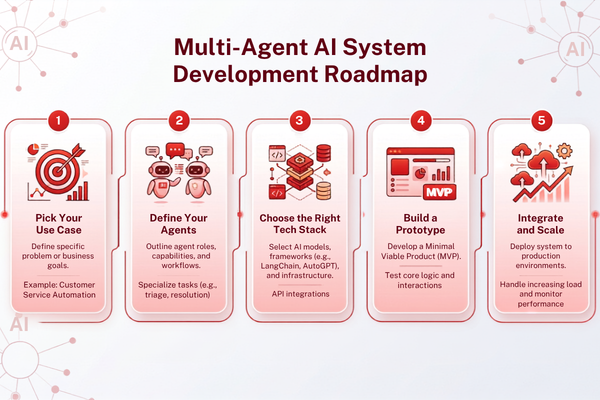
How to Get Started: A Simple Roadmap
Starting does not have to be overwhelming. Follow these steps.
Step 1: Pick Your Use Case
What problem do you want to solve? Be specific. A clear goal leads to a better system.
Step 2: Define Your Agents
What roles do you need? Start with two or three agents. Keep it manageable at first.
Step 3: Choose the Right Tech Stack
Talk to a technical partner early. Your stack should match your business environment and goals.
Step 4: Build a Prototype
Test your idea before going all in. A working prototype saves money and reveals problems early.
Step 5: Integrate and Scale
Once your prototype works, connect it to your systems. Then grow it at a pace that works for you.
Want to see what a well-planned AI project looks like in practice? The Luca project shows how thoughtful AI development can solve real user problems effectively.
What the Experts Are Saying
The data and expert voices all point in the same direction.
- OpenAI has built multi-agent frameworks into its developer tools. This lets companies build autonomous agent systems at scale.
- Google AI research shows that agent collaboration outperforms single-model AI on complex tasks by a wide margin.
- Gartner predicts that by 2026, more than 80 percent of enterprises will use generative AI in production, and many of those systems will use multi-agent architecture.
agent-based systems are not a niche trend. They are becoming the standard.
Start Your AI Development Project
Your competitors are already exploring this technology. Now is the time to act.
At Canadian Software Agency, we help businesses design and build AI systems that work in the real world. Our team has experience across healthcare, fintech, SaaS, and e-commerce.
Here is what you can expect when you work with us:
- A free consultation to understand your goals
- A custom roadmap built for your business size and budget
- Agile development so you see real progress at every stage
- Ongoing support after launch to keep your system performing well
Our AI development services are built for businesses that want real results, not just impressive demos.
Take the first step today. Estimate your project and let us build something that actually moves your business forward.
Conclusion:
The shift has already happened.
Multi-Agent Systems have moved from research labs into real businesses. They are cutting costs, speeding up workflows, and helping companies make better decisions every single day.
This is not about chasing the latest tech trend. It is about staying competitive in a world where AI is becoming a core part of how businesses operate.
The benefits are real and measurable. You get faster processes. You get fewer errors. You get a system that works around the clock and grows with your business. You also free up your human team to do the work that truly matters: thinking, creating, and building relationships.
Starting with collaborative AI systems does not have to be complicated. You do not need to build everything at once. Start with one clear use case. Prove the value. Then scale from there.
The businesses winning right now are the ones that started early. They tested small, learned fast, and grew their systems with confidence.
You can do the same.
The right partner makes all the difference. A team that understands both the technology and your business goals will help you avoid costly mistakes and build something that lasts.
Agent-based systems are not the future of AI. They are the present. And the businesses that treat them as a priority today will be the ones leading their industries tomorrow.
Do not wait for the perfect moment. The best time to start is now.
Frequently Asked Questions
Q1: What is a Multi-Agent System in simple terms?
A Multi-Agent System is a group of AI programs. Each one handles a specific task. Together, they complete bigger, more complex goals like a team of specialists working on one project.
Q2: How are agent-based systems different from a regular chatbot?
A chatbot handles one conversation at a time. A Multi-Agent System runs many tasks at once, coordinates between agents, and can manage entire business workflows on its own.
Q3: How much does it cost to build one?
A basic setup can start around $75,000. Enterprise-level systems can go above $250,000. Starting with a small prototype keeps your initial costs under control.
Q4: Which industries benefit the most?
Healthcare, finance, e-commerce, logistics, and SaaS companies are seeing the strongest results. But the technology works for any business with complex or repetitive workflows.
Q5: How long does it take to build?
A working prototype usually takes 8 to 16 weeks. A full deployment with integrations can take 4 to 9 months depending on your needs and team size.