Building LUCA.ai: An AI-Powered Literacy & Learning Platform

A modern educational technology website designed to communicate LUCA’s AI-driven literacy platform through engaging storytelling, scalable content architecture, responsive user experiences, and conversion-focused digital strategy.

Industry

EdTech & Artificial Intelligence

Platform

Webflow Website

Launch

2025

About the LUCA.ai

LUCA.ai is an AI-powered literacy platform built to help struggling readers improve their reading abilities through personalized phoneme-level learning experiences. The platform combines artificial intelligence, speech recognition, and adaptive learning technologies to support students, parents, and educators.

As an emerging EdTech company, LUCA required a modern digital platform capable of clearly communicating complex educational technology concepts while remaining approachable, trustworthy, and emotionally engaging.

The website needed to serve multiple audience groups simultaneously, including schools, educators, parents, and investors, while positioning LUCA as a forward-thinking leader in AI-driven literacy solutions.

Timeline

2025

Total Development Effort

250+ Hours across all departments

Team Size

6+ specialists

Key Deliverables
UI/UX Design
Web Development
CMS Architecture

The Challenge

The primary challenge was translating advanced AI and literacy technology into a user-friendly website experience that felt both educational and approachable.

The project required balancing technical credibility with emotional storytelling while maintaining strong conversion pathways for demos, inquiries, and partnerships.

Major challenges included:

The Solution

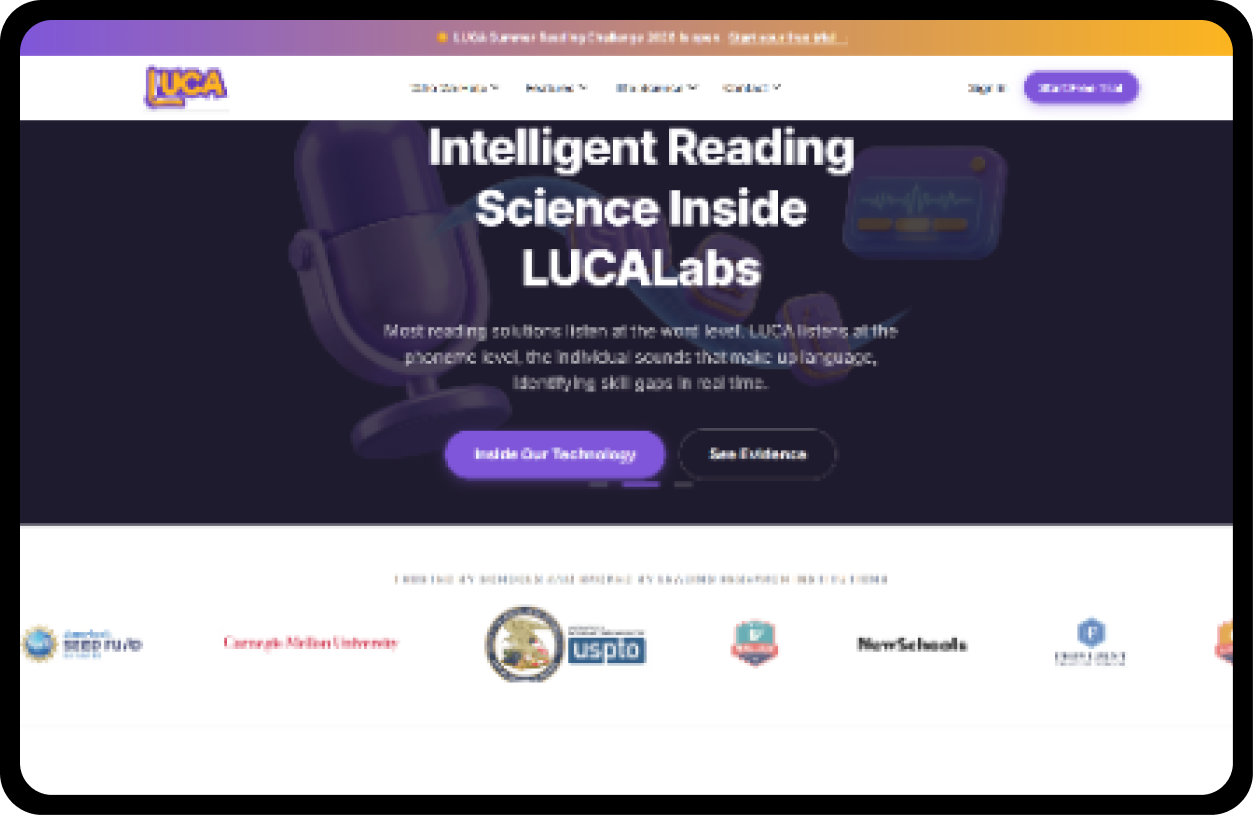
Canadian Software Agency designed and developed a modern educational technology website focused on storytelling, accessibility, and strategic content presentation.

The website was structured to guide visitors through LUCA’s mission, platform capabilities, and educational impact using clean layouts, visual hierarchy, and conversion-focused sections.

The solution emphasized:

The final platform successfully positioned LUCA as an innovative and trustworthy EdTech solution provider.

Core Platform Features

The project began with a strategic planning and discovery phase focused on understanding LUCA’s target audiences, educational objectives, and long-term growth plans.

AI Platform Storytelling

Structured content sections designed to explain LUCA’s AI-powered literacy technology in a simplified and engaging format.

Multi-Audience Navigation

User journeys tailored for parents, educators, schools, and institutional stakeholders.

Responsive User Experience

Fully responsive layouts optimized across desktop, tablet, and mobile devices.

Scalable CMS Architecture

Flexible content management structure supporting future educational resources, updates, and marketing initiatives.

Conversion-Focused Layouts

Strategically designed sections encouraging demo requests, partnerships, and contact inquiries.

Installation Showcase Galleries

Optimized frontend structure ensuring smooth browsing despite visually rich content and animations.

The Modern Stack Behind the Software.

A modern, production-ready stack was selected to support real-time interactions, cross-platform mobile delivery, and scalable deployment.

Core Technologies
Webflow
Custom CSS
JavaScript
Responsive Design
CMS Development
Supporting Infrastructure & Services
CMS Architecture
SEO Optimization
Interactive UI Components
Performance Optimization
Mobile Optimization

See LUCA.ai in Action

LUCA.ai established a more modern and credible digital presence.

Project Timeline

EcoTech Windows & Doors launched with a modern, high-performance digital experience designed to improve customer trust, lead generation, and long-term SEO scalability.

Discovery & Planning

The project began with a strategic planning and discovery phase focused on understanding LUCA’s target audiences, educational objectives, and long-term growth plans.

Planning activities included:

  • Researching competitor EdTech and AI learning platforms.
  • Mapping audience-specific user journeys for parents, schools, and educators.
  • Structuring scalable content architecture for future expansion.
  • Defining conversion goals including demos, contact requests, and partnership inquiries.
  • Planning storytelling-focused layouts to simplify technical concepts visually.
  • Identifying performance optimization opportunities for media-rich sections.

The planning phase established a strong foundation for both the UX strategy and technical implementation.

Design & User Experience

The website design focused on balancing educational professionalism with approachable, modern visuals.

Key design principles included:

  • Clear visual hierarchy simplifying complex educational information.
  • Modern UI layouts supporting storytelling and user engagement.
  • Clean typography and accessible content presentation improving readability.
  • Strategic CTA placement driving demos and user inquiries.
  • Responsive layouts optimized for schools, educators, and parents browsing across devices.
  • Consistent branding reinforcing trust, innovation, and accessibility.

The design system ensured consistency throughout the website while supporting scalability for future content additions.

Frontend Development (Webflow)

The website was developed using Webflow with responsive custom layouts and interactive content sections designed to support modern storytelling experiences.

Development focused heavily on balancing performance with visually engaging content presentation.

CMS & Content Architecture

A scalable CMS structure was implemented allowing the client to easily manage content updates, educational resources, and future expansion initiatives without requiring significant redevelopment.

Testing & Launch

Quality assurance included:

  • Cross-browser compatibility testing.
  • Responsive validation across desktop, tablet, and mobile devices.
  • UX testing for navigation clarity and conversion flow consistency.
  • Performance optimization for media-rich content sections.
  • CMS validation and scalability testing.
  • Accessibility and readability reviews for educational content.

Following final client approval, the website was successfully launched with a scalable structure supporting future platform growth.

Key Outcomes

Storytelling-focused layouts increased content clarity and audience engagement.

Website + CMS Artitechture
0
Weeks comprehensive engagement from kickoff to live production
0
Core feature modules built, integrated, and tested
0 +
QA pass rate with zero blocking issues at launch
0 %
Responsive experience across desktop and mobile devices
0 %

Related Case Studies

Frequently Asked Questions

The cost of mobile app development in Canada typically ranges from $10,000 to $150,000+, depending on the complexity, features, and platforms involved. A basic MVP app may cost between $10,000–$25,000, while more advanced applications with integrations, real-time features, or AI capabilities can exceed $100,000.

Factors affecting cost include UI/UX design, backend infrastructure, APIs, scalability requirements, and whether the app is built natively or cross-platform

The timeline for mobile app development usually ranges from 8 weeks to 6 months. A simple MVP can be completed in 6–10 weeks, while complex applications with advanced features, integrations, or AI components may take 4–6 months or longer.

Proper planning, clear requirements, and an experienced development team significantly reduce timelines.

Native apps are built specifically for iOS (Swift) or Android (Kotlin), offering maximum performance and full access to device features. Cross-platform apps (React Native, Flutter) allow faster development and lower costs by using a shared codebase.

The choice depends on your budget, performance needs, and time-to-market requirements.

AI development is widely used across industries including:

  • Healthcare (diagnostics, patient management)
  • Fintech (fraud detection, analytics)
  • E-commerce (recommendation engines)
  • Logistics (route optimization)
  • Education (adaptive learning)

Businesses that rely on data, automation, or personalization benefit the most from AI integration.

An AI agent is a system that can perform tasks autonomously using artificial intelligence. It can analyze data, make decisions, and execute actions without constant human input.

Examples include chatbots, workflow automation tools, and AI assistants integrated into business systems.

RAG (Retrieval-Augmented Generation) is an AI approach that combines large language models with real-time data retrieval. It allows AI systems to generate more accurate and context-aware responses using external knowledge sources.

It is commonly used in chatbots, enterprise search systems, and AI assistants.

Yes, we specialize in SaaS (Software as a Service) development, building scalable cloud-based platforms for startups and enterprises. Our SaaS solutions include subscription systems, dashboards, user management, and integrations.

We use modern technologies including:

  • React, Next.js (frontend)
  • Nodejs, Python (backend)
  • MongoDB, PostgreSQL (databases)
  • AWS, Azure (cloud)
  • React Native, Flutter (mobile)

Yes, we provide ongoing support, maintenance, and scaling services. This includes bug fixes, performance optimization, feature updates, and infrastructure management.

Yes, we specialize in scaling existing applications by improving performance, optimizing architecture, and adding new features to support growth.

Custom software development typically ranges from $20,000 to $200,000+, depending on the complexity, integrations, and scalability requirements.

We work with both startups and enterprises. For startups, we focus on MVP development and rapid deployment. For enterprises, we build scalable, secure, and integrated systems.

The best tech stack depends on your goals. Native development (Swift/Kotlin) offers performance, while React Native and Flutter offer faster development and cost efficiency.

Yes, we provide full UI/UX design services including wireframes, prototypes, and user experience optimization.

Our AI services include AI agents, LLM integration, RAG systems, chatbots, predictive analytics, and automation solutions.

We follow best practices including encryption, secure authentication, compliance standards, and regular security audits.

Yes, we build enterprise-grade applications including CRM, ERP, dashboards, and workflow automation systems.

Our process includes discovery, design, development, testing, deployment, and ongoing support.

Yes, we integrate APIs including payment gateways, CRMs, AI services, and more.

AI automation uses artificial intelligence to automate repetitive tasks, improve workflows, and reduce manual effort.

Yes, we build scalable e-commerce platforms with payment integrations, inventory systems, and AI-driven personalization.

We combine AI expertise, mobile app development, and custom software capabilities under one roof, allowing us to deliver complete digital solutions.

Yes, we deploy applications on AWS, Azure, and other cloud platforms for scalability and reliability.

Yes, we help businesses modernize outdated systems by upgrading technology and improving performance.

You can contact us through our website to schedule a consultation where we discuss your project requirements and provide a tailored solution.

Ready to work together?

Let's get in touch