

AI is no longer a “future” idea. It is a practical tool that helps companies cut costs, move faster, and serve customers better. But results do not come from random pilots or one-off tools. They come from a clear AI roadmap for business success, one that aligns with your goals, your data, and your team.
A successful AI roadmap combines strategy, implementation planning, data readiness, governance, and measurable ROI goals.
In this blog, you will learn how to plan, build, and scale AI in a way that creates real business value. We will cover what to do first, what to avoid, and how to track results. You will also see cost ranges, use cases, and a simple step-by-step approach you can apply in your company.
This guide is written for business leaders and product teams in mobile-first companies. If you want growth, better efficiency, and smarter decisions, this roadmap will help you get there without heavy jargon or confusing theory.
What is an AI roadmap for business?
An AI roadmap is a structured plan that helps companies identify, prioritize, build, deploy, and scale AI solutions to achieve measurable business goals. It defines use cases, timelines, data requirements, ownership, technology choices, governance policies, and ROI metrics.
1) Why AI Matters for Modern Businesses
AI is helping teams do more with less. It also helps companies compete in markets where speed matters.
Benefits of AI automation include:
- reduced operational costs
- faster workflows
- improved accuracy
- fewer manual errors
- better customer response times
- smarter planning with better forecasts
AI is not only for big tech. AI for businesses works in retail, logistics, finance, real estate, healthcare, and service firms.
If you start with a clear AI strategy, you reduce risk and get value sooner.
2) Core Phases of an AI Roadmap
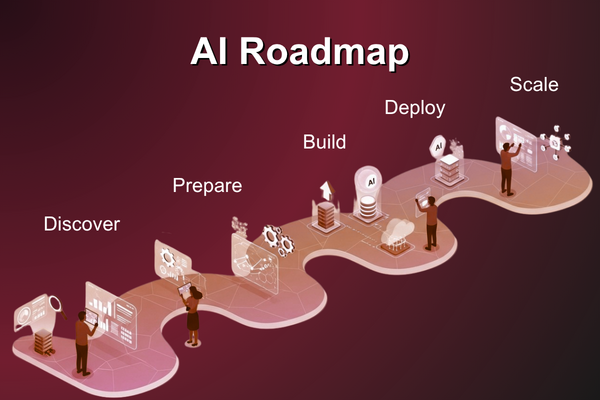
A strong AI roadmap usually follows these phases:
- Discover: find high-value use cases
- Prepare: fix data, access, and privacy
- Build: create models, apps, and workflows
- Deploy: roll out safely with monitoring
- Scale: expand to more teams and processes
This is the base of an AI implementation roadmap that stays realistic and measurable.
Keep it simple with 3 workstreams
Most companies succeed faster when they run three workstreams in parallel:
- Business: goals, ROI, and use-case priority
- Data: quality, access, security
- Product: app build, user flow, adoption
3) Set goals that AI can actually support
Many AI projects fail because goals are vague. Tie AI to outcomes that leaders care about.
Good goal examples:
- Cut support response time by 30%
- Reduce fraud review workload by 40%
- improve lead qualification accuracy by 20%
- increase customer retention by 5%
This is where your artificial intelligence strategy becomes real.
Use a simple value filter
Before you build anything, score each use case by:
- business impact
- data availability
- time to launch
- Risk and compliance needs
This makes AI planning for companies more focused and less political.
4) Pick the best AI use cases (quick wins + long-term bets)
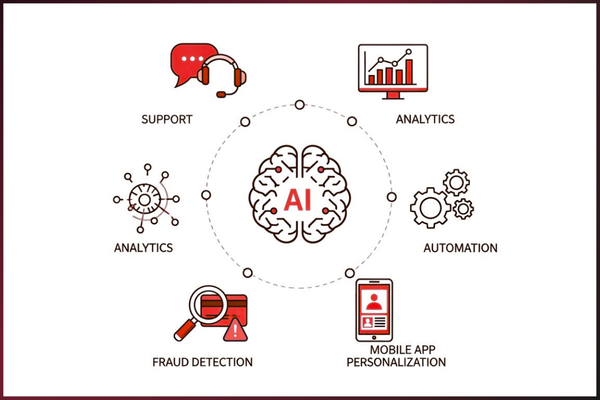
A good AI adoption strategy blends fast wins with larger transformation work.
Quick win use cases (4–10 weeks):
- AI customer support chatbot
- document and invoice extraction
- meeting summaries for internal teams
- email triage and response drafting
- product search improvement
Medium-to-long use cases (3–9 months):
- demand forecasting
- dynamic pricing suggestions
- risk scoring and fraud signals
- personalized user journeys in your mobile app
Generative AI for business is especially useful for customer support, content generation, internal knowledge search, onboarding assistance, and workflow automation. Many companies begin with generative AI because it delivers measurable productivity gains quickly. If you want inspiration from real product delivery, you can review how teams have shipped digital platforms in the GreenTag project, where user experience and scalable delivery are two key needs when AI features enter a product.
5) Data readiness: the part most roadmaps ignore

Your AI roadmap for business is only as strong as your data access and data quality.
Focus on:
- where data lives (CRM, app, ERP, support tools)
- Who owns it
- whether it is clean and labeled
- What is private or regulated
- How often does it update
A practical data checklist
- Do we have enough examples for training or prompts?
- Can we legally use the data?
- Is there a single “source of truth”?
- Can we monitor drift and errors over time?
This step supports reliable business AI implementation. It also reduces surprise costs later.
6) Choose your build approach (buy, build, or blend)
AI can be built in different ways. The right answer depends on speed, budget, and control.
Common approaches:
- Buy: use SaaS AI tools (fast, less custom)
- Build: custom AI features in your apps (more control)
- Blend: use APIs + custom workflows (often best)
Many companies use platforms like OpenAI to accelerate language-based AI features, while Google AI provides scalable cloud AI infrastructure and model options.
This decision is central to your AI strategy and your AI integration strategy.
7) AI development cost ranges (simple planning table)
Costs depend on scope, data work, integration, and security needs. Use this as a planning baseline.
| AI Development Type | Estimated Cost |
| AI Chatbot Development | $10k – $50k |
| AI SaaS Platform | $50k – $200k |
| Enterprise AI System | $100k+ |
What drives the cost up?
- integrations with many systems
- complex data cleanup
- compliance requirements
- real-time performance needs
- Ongoing monitoring and tuning
8) Build features users will trust (Feature → Benefit table)
Your AI roadmap should include user-facing and internal features that drive adoption. Trust matters. Clarity matters.
| Feature | Benefit |
| Human-in-the-loop review | reduces mistakes in high-risk steps |
| Clear “why” explanations | improves trust and approval rates |
| Feedback buttons (good/bad) | improves quality over time |
| Role-based access control | protects sensitive data |
| Audit logs | supports compliance and accountability |
Keep AI inside the workflow
AI works best when it is placed inside tools people already use:
- mobile app flows
- admin dashboards
- CRM screens
- support consoles
That is how AI transformation becomes daily behavior, not a side project.
9) Governance and risk: make it safe and scalable
AI introduces new risks. Your enterprise AI strategy must address them early.
Key governance steps:
- define who approves AI use cases
- set rules for data use and retention
- create testing standards (bias, safety, accuracy)
- Define incident response steps
- Monitor output quality over time
Simple policies that prevent big problems
- Never send private user data into tools without approval
- Mark AI-generated content clearly in internal tools
- require review for legal, medical, or financial advice content
This is essential for responsible business AI implementation.
Governance frameworks from organizations like IBM AI Governance can help enterprises create safer and more accountable AI systems.
10) Rollout plan: adoption beats “launch day.”
Many AI projects “work” but fail because teams do not use them. Your AI adoption framework needs a rollout plan.
Rollout best practices:
- Start with one team
- train users with short guides
- Use real examples from their daily work
- track usage weekly
- keep improving based on feedback
For example, if your product has multiple user roles and complex flows, studying structured delivery from projects like the SLO digital project can remind teams that adoption depends on user experience, not only tech.
11) AI Change Management and Team Training
Define new roles and owners
- AI product owner (ties AI work to business goals)
- data steward (keeps data clean and usable)
- AI reviewer (checks outputs in high-risk tasks)
Train teams with simple, repeatable habits
- short training sessions (30–45 minutes)
- “Prompt and policy” quick guides
- internal examples based on real workflows
Communicate what AI will and won’t do
- sets the right expectations
- reduces fear and resistance
- increases adoption across teams
12) Metrics and ROI: prove AI business growth
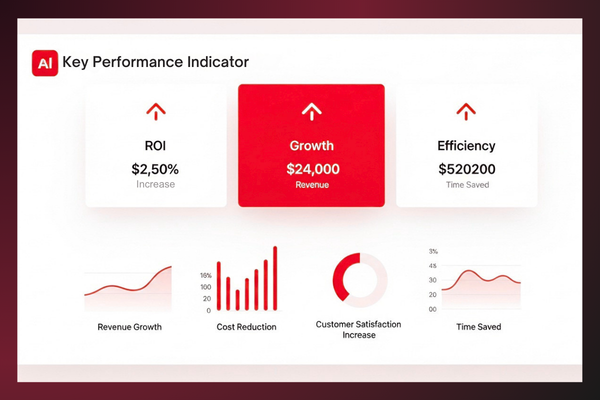
If you cannot measure it, you cannot scale it. Your AI roadmap should define success metrics before building.
Track metrics like:
- cost per ticket (support)
- time saved per process
- conversion rate changes
- churn reduction
- customer satisfaction score
- error rate and rework rate
A simple ROI formula
ROI = (value gained − total cost) / total cost
Value gained can include:
- labor hours saved
- new revenue from better conversion
- fewer refunds and errors
- improved retention
This creates a clear path to AI business growth and makes future budget approval easier.
13) Common AI Roadmap Mistakes to Avoid
- starting with unclear goals
- poor data quality
- choosing AI tools before defining workflows
- ignoring user adoption
- skipping governance policies
- failing to measure ROI
14) Start Your AI Development Project
If you are planning an AI implementation roadmap for your mobile product or business platform, the right development team can help you move faster while reducing risk. You need a roadmap plus a team that can execute it.
When you are ready, explore our AI services for product teams to plan, build, and scale secure AI solutions. We focus on practical outcomes: faster workflows, better user experience, and measurable ROI.
If you are still shaping the scope, you can also use our project estimation approach to map timelines, costs, and delivery phases with clarity.
Conclusion
A strong AI roadmap for business is not a document you create once and forget. It is a working plan that helps your company stay focused while AI tools, customer needs, and market pressure keep changing. When built the right way, it creates momentum. It also protects you from the most common failure pattern: running scattered pilots that never reach real users or real ROI.
To drive results, keep the roadmap tied to business outcomes. Start with clear goals like cost reduction, faster service, higher conversion, or fewer errors. Then pick use cases based on impact and feasibility, not hype. This step alone improves decision-making and helps leaders support the program. Next, invest in data readiness. Even simple AI tools depend on clean, accessible data and clear ownership. If your data foundation is weak, your results will be weak too.
From there, choose the right build approach. Some teams move fast by using APIs and proven platforms. Others need custom work for a deeper product advantage. Either way, your AI roadmap should include security, governance, and rollout planning. AI must be safe. It must also be adopted. That means placing AI inside the workflow, training teams in short sessions, and using feedback loops to improve quality over time.
Finally, measure value like a business. Track time saved, cost per process, customer satisfaction, and conversion lifts. When your metrics are visible, it becomes easier to scale AI across departments. That is how AI stops being a “cool feature” and becomes a reliable growth engine.
If you want to move from ideas to execution, treat your roadmap like a product: prioritize, test, ship, learn, and expand. With the right AI roadmap, you can build smarter mobile experiences, improve internal operations, and create a lasting competitive advantage.
FAQs
1) How long does an AI roadmap for business take to create?
Most companies can create a practical first version in 2–4 weeks. Complex enterprises may take longer if data and compliance reviews are heavy.
2) What is the difference between an AI strategy and an AI development roadmap?
An AI strategy defines goals, priorities, and principles. An AI development roadmap turns that into build phases, timelines, owners, and releases.
3) What is a good first AI project for a mobile app?
Common starting points include support automation, smart search, onboarding personalization, or content summarization use cases that are easy to test and measure.
4) How do we avoid risk during business AI implementation?
Use role-based access, audit logs, human review for sensitive tasks, and clear data rules. Also, monitor performance after launch.
5) What if we do not have enough data?
You can start with AI systems that use prompts and existing knowledge bases. Over time, collect better data through feedback and structured labeling.