
Multimodal Artificial Intelligence is transforming how businesses operate. Unlike older tools that handled only one type of data, this technology processes text, images, audio, and video together in a single system. For business owners, that means fewer tools, lower costs, and smarter results.
This guide explains what multimodal AI is, how it works, and how your business can use it practically. You will also find real examples, honest cost estimates, and security advice.

Why Businesses Are Moving Toward Multimodal AI
Every business handles multiple types of data daily. Customers send emails, upload product photos, leave voice messages, and post video reviews. Managing all of that with separate tools is expensive and slow.
A unified AI system that understands all of these inputs together changes that equation entirely. Instead of running four different tools, you run one. Instead of stitching results together manually, the system delivers a single, informed response.
This is the core value multimodal Artificial Intelligence brings to modern businesses:
- Reduced costs from consolidating multiple tools into one
- Faster workflows through automation of repetitive tasks
- More accurate results because the AI sees the full picture, not just part of it
- Better customer experiences through faster, more relevant responses
- Scalability as the system grows alongside your business
Big companies like Google and OpenAI are already spending billions on this technology. You can learn more about how OpenAI is building these systems on the OpenAI research page.
We helped a business completely improve how they work online. See how we delivered results in this real-life example, which shows what smart technology choices can do for a business.
What Multimodal AI Actually Is
Multimodal AI is an artificial intelligence system that processes more than one type of data simultaneously. It can read text, analyse images, interpret audio, and examine video within a single pipeline.
Traditional AI systems were built differently. A text tool handled text. An image tool handled images. An audio tool handled audio. If your business needed all three, you needed three separate systems with separate costs, separate maintenance, and separate teams managing them.
A simple example: A customer photographs a damaged product and types a question about it. A multimodal system looks at the photo and reads the question at the same time. It then delivers one coherent, informed answer rather than treating them as two unrelated pieces of information.
That combination of inputs produces a far more useful response than either input could generate alone.
How Multimodal AI Works
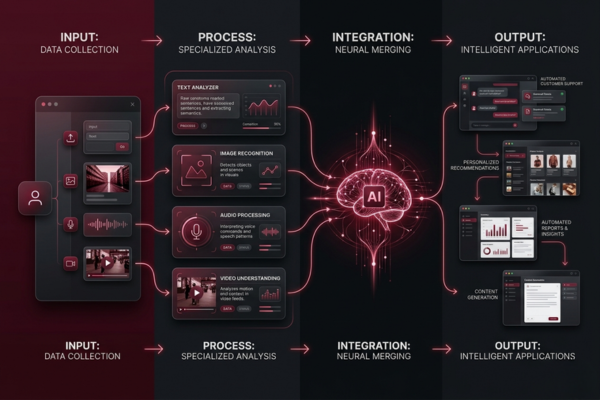
The process follows four clear steps.
Step 1: You provide input
You send the AI one or more types of data. This might be a written message, a photograph, a voice recording, or a short video clip.
Step 2: Each input is processed separately
Inside the system, specialised components handle each data type. A language model reads the text. A vision model analyses the image. An audio model interprets sound.
Step 3: The system connects the inputs
This is the critical step. The AI links what it has learned from each source. It understands how the image relates to the text, or how the audio context changes the meaning of the written message.
Step 4: A unified response is delivered
The system produces a single, informed output. This might be a written reply, a recommendation, a decision, or even a generated image or spoken response.
The result is an AI that thinks more like a human, drawing on everything available rather than working with only part of the information.

Leading Multimodal AI Models Available Today
Several capable systems are available to businesses right now.
| AI Model | Developer | Supported Inputs |
|---|---|---|
| GPT-4o | OpenAI | Text, images, audio |
| Gemini Ultra | Google DeepMind | Text, images, audio, video |
| Claude 3 | Anthropic | Text, images |
| LLaVA | Open Source | Text, images |
| Flamingo | DeepMind | Text, images |
These models are trained on vast datasets and can handle complex, real-world business tasks. You can compare how different models perform on practical tasks through the LMSYS Chatbot Arena, which ranks systems based on actual user evaluations.
Choosing the right model depends on what types of data your business needs to process and what level of customisation you require.
Real Business Applications Across Industries
Multimodal Artificial Intelligence is already being used across a wide range of sectors. Here are concrete examples of how different industries are applying it.
Healthcare
A clinician uploads a patient scan alongside typed notes. The AI analyses the image and reads the text simultaneously, helping to flag potential findings and reduce time spent on manual review.
Retail and eCommerce
A customer photographs a product they like and asks whether it is available in a different colour. The AI identifies the product from the photo and answers the question directly, improving the shopping experience without any human intervention.
Education
A student submits a voice recording of themselves reading aloud, along with a written response. The AI assesses both inputs together, providing detailed feedback on pronunciation, comprehension, and writing quality.
Customer Support
A customer sends a short video of a malfunctioning item and types a description of the problem. The AI reviews both, identifies the issue, and provides an immediate resolution without escalating to a human agent.
Legal
Contracts, recorded meetings, and audio testimonies are processed together. The AI extracts relevant details from each source, significantly reducing the time required for document review.
Finance
Written reports are analysed alongside data charts and graphs. The AI interprets the numbers visually and contextually, supporting faster and more informed financial decisions.
Multimodal AI Use Cases Across Different Industries
We built a mobile platform for a sports business. Here is a simple table showing multimodal Artificial Intelligence use cases in different industries that combine data and user activity in a smart way. Learn from this real-life example, which shows how mobile apps can bring AI thinking into the sports world in a practical way:
| Industry | How Multimodal Artificial Intelligence Is Used | Business Benefit |
| Healthcare | Looks at scans and reads doctor notes | Faster and better diagnosis |
| Retail | Visual product search and text answers | Better shopping experience |
| Education | Grades audio and written answers together | Fair and faster student feedback |
| Legal | Reviews documents and audio recordings | Faster case processing |
| Marketing | Creates images and writes copy together | Faster content production |
| Finance | Reads reports and analyzes data charts | Smarter financial decisions |
| Real Estate | Matches photos with written property details | Better property search results |
| Sports and Fitness | Watches video and reads performance data | Personalised coaching plans |
Multimodal AI Versus Generative AI
These two terms are often used interchangeably, but they describe different capabilities.
Generative AI focuses on creating new content. You provide a prompt, and the system produces text, an image, or another output. A tool that writes product descriptions from a brief is an example.
Multimodal Artificial Intelligence focuses on understanding and processing multiple types of input simultaneously. A system that reads a customer complaint and analyses an attached photo to produce a relevant reply is an example.
The important distinction is that many modern systems are now both. GPT-4o, for instance, can understand images and audio while also generating written or spoken responses. For most businesses, the practical question is not which category a tool belongs to, but what specific problem it solves.
If you need to produce content faster, generative AI features are most relevant. If you need to make sense of complex, mixed data from customers or operations, multimodal capabilities are essential. Used together, they cover the full range of business needs.

Key Benefits for Business Owners
The advantages of multimodal Artificial Intelligence extend well beyond novelty. Here is what businesses typically experience when they implement these systems thoughtfully.
Accuracy improves because the AI interprets a fuller context. A system that reads text and sees an image makes fewer errors than one working from a single source.
Decisions happen faster because the system processes multiple inputs in seconds rather than routing them through separate tools and teams.
Customer satisfaction increases because responses are more relevant and arrive more quickly.
Operational costs fall because one integrated system replaces several standalone tools.
Competitive advantage grows because businesses that adopt early are better positioned than those who wait.
Teams become more productive because staff are freed from repetitive manual processing and can focus on higher-value work.
The underlying principle is straightforward. When an AI understands more, it performs better. When it performs better, your business benefits.
How Much Does Multimodal AI Development Cost?
Cost varies significantly depending on the complexity of what you are building. Here is a realistic breakdown to help you plan.
| Project Type | Estimated Cost | What Is Included |
|---|---|---|
| Basic multimodal chatbot | $10,000 – $30,000 | Text and image processing with automated replies |
| Custom AI mobile application | $30,000 – $80,000 | Full app with integrated AI features |
| Industry-specific AI platform | $80,000 – $150,000 | Tailored for sectors like healthcare or legal |
| Enterprise AI system | $150,000 – $500,000+ | Large-scale deployment for complex organisations |
| Multimodal SaaS product | $50,000 – $200,000 | Scalable platform built for multiple users |
Several factors influence the final figure. These include how many data types the system must handle, how much custom training the AI requires, whether it needs to connect with your existing tools, and what security or compliance standards apply to your industry.
The most effective approach for most businesses is to start with one well-defined problem, build a focused solution, measure the results, and expand from there.
Security Considerations for Business AI Systems
Deploying AI responsibly requires attention to security from the beginning. These ten practices cover the essentials.
- Encrypt data in transit and at rest to prevent unauthorised access
- Control user permissions so team members only access what they need
- Remove personally identifiable information before sending data to any AI model
- Review AI outputs regularly to catch errors, inconsistencies, or bias early
- Choose compliant providers that meet standards such as GDPR or HIPAA, depending on your industry
- Limit third-party data sharing and understand exactly what each integrated tool can access
- Set usage limits to prevent misuse or runaway costs
- Conduct quarterly audits of your AI system to identify and address any emerging risks
- Train your team on safe and responsible AI use before deployment
- Prepare an incident response plan, so you know exactly what to do if something goes wrong
Security should be part of the design process, not an afterthought. Building it in from the start is always easier and less costly than retrofitting it later.
Core Features and Their Business Impact
| Feature | Business Benefit |
|---|---|
| Simultaneous text and image analysis | Smarter support and more accurate product matching |
| Audio processing | Automated call analysis and voice-enabled interfaces |
| Video understanding | Quality control, training review, and security monitoring |
| Real-time response capability | Faster service and reduced customer wait times |
| Multi-language support | Broader market reach without additional staffing |
| Scalable architecture | System grows with demand without requiring a rebuild |
| Custom model training | AI that understands your specific industry and terminology |
| API integration | Connects to your existing tools and workflows |
| Mobile compatibility | AI features delivered directly through your app |
| Performance reporting | Clear data on results and return on investment |
Start Your AI Development Project
The most common mistake businesses make with AI is trying to do too much at once. A better approach is to identify one area where mixed data is already causing delays or errors, and solve that specific problem first.
Once you see results from a focused implementation, you will have a much clearer picture of where to invest next. That approach also reduces risk and makes it easier to demonstrate value to stakeholders.
If you are ready to build something smart for your business, visit here and start your project today.
Conclusion
Multimodal AI is a practical business tool that is already delivering measurable results across healthcare, retail, education, legal, finance, and more. It processes text, images, audio, and video together, producing smarter outcomes than any single-input system can achieve.
This guide has covered the fundamentals of how the technology works, the leading models available today, realistic development costs, security best practices, and concrete industry applications. The technology is mature enough to deploy now, and the businesses adopting it early are building advantages that will be difficult for slower-moving competitors to close.
The right next step depends on your business. But the first step is simply deciding to start.
Frequently Asked Questions
What is multimodal Artificial Intelligence in simple terms?
It is an AI system that processes more than one type of data at the same time. Rather than reading only text or analysing only images, it handles both together, along with audio and video, to produce more accurate and useful results.
What are the most capable multimodal Artificial Intelligence systems today?
GPT-4o by OpenAI, Gemini Ultra by Google DeepMind, and Claude 3 by Anthropic are among the strongest options currently available. Each has different strengths depending on the types of data you need to process.
How much does it cost to build a multimodal Artificial Intelligence solution?
A basic implementation typically starts around $10,000. Complex enterprise systems can exceed $500,000. The right budget depends on your specific requirements, including how many data types are involved, what integrations are needed, and what compliance standards apply.
How does multimodal Artificial Intelligence differ from generative AI?
Generative AI creates new content from a prompt. Multimodal Artificial Intelligence understands and processes multiple input types simultaneously. Many modern systems combine both capabilities, understanding images and audio while also generating written or spoken responses.
Is multimodal Artificial Intelligence safe for business use?
Yes, when implemented with proper safeguards. Encrypting data, controlling access, removing sensitive information before processing, and working with compliant providers are the most important steps. Regular audits and staff training are also essential for maintaining security over time.